
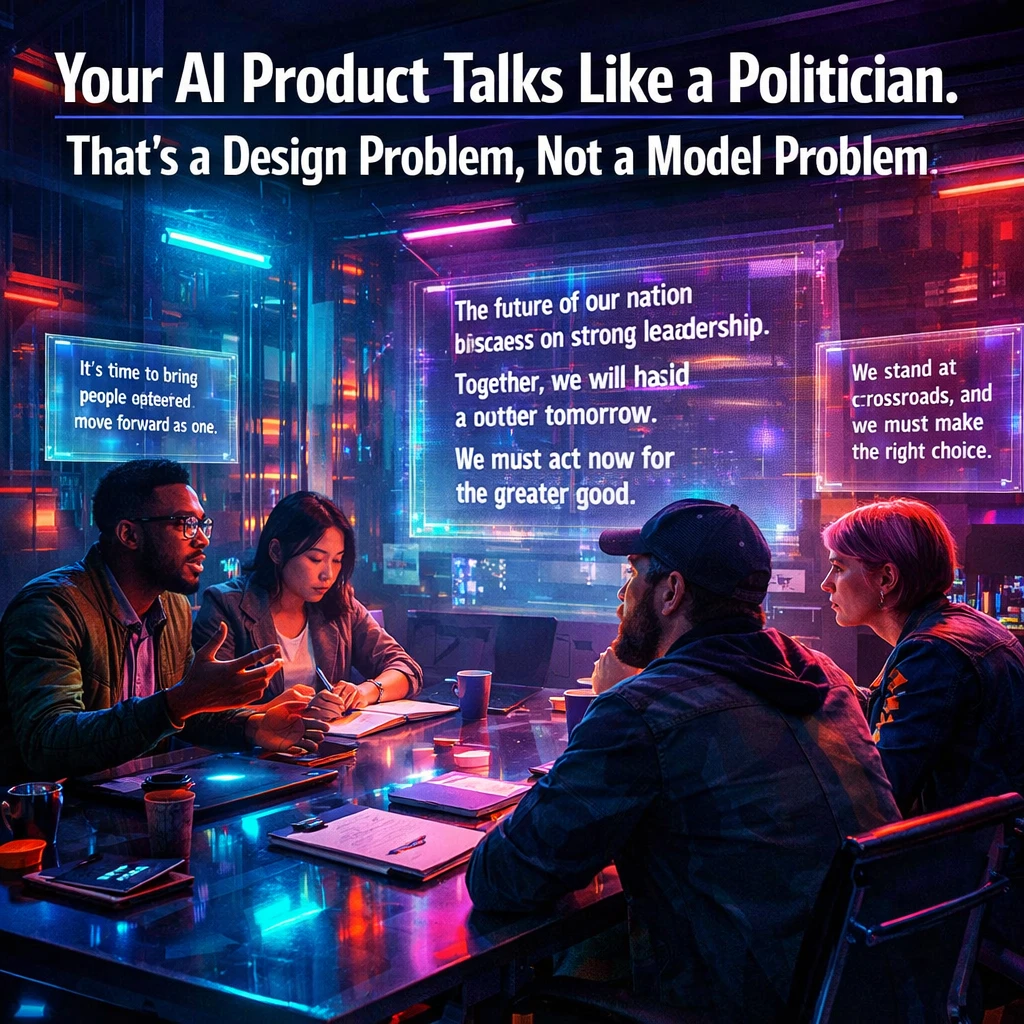


AI products often present polished yet evasive communication, raising concerns about authorship and truthfulness. The merging of AI-generated content into user experiences contributes to users’ trust fatigue, as they struggle to discern authenticity and accuracy.
To create effective AI products, it is essential to clarify the AI’s limitations, ensure transparency regarding sources, and integrate a human perspective in design. Focusing on meaningful engagement metrics rather than superficial ones can help foster trust and comprehension, ultimately leading to a more responsible use of AI in product design.
AI products are starting to sound like the worst kind of politician: fluent, polished, and fundamentally evasive.
When a book about “truth in the age of AI” ships with more than half a dozen quotes that were simply invented by chatbots, the issue isn’t just one careless author. It’s a system where we’ve normalised letting probabilistic text generators stand in for actual thought – and then acting surprised when reality gets bent. The same culture that shrugs at made‑up quotes in a nonfiction book is the one shipping AI‑powered onboarding, support, and “assistants” into products without a single serious conversation about voice, provenance, or accountability.
When AI sludge escapes the doc and enters the product
The literary world just had its own AI farce: a Commonwealth Short Story Prize winner pulled into a scandal because critics argued the story showed “obvious markers of AI,” backed by detectors that flagged it as machine‑generated. The Foundation refused to hand manuscripts to AI detectors over consent and ownership concerns, relying instead on human attestations and trust between judges and writers. That entire mess only exists because the generic, AI-ish voice has become so ubiquitous that readers no longer trust their own sense of what’s human.
Now map that into product.
The same LLMs that hallucinated quotes and blurred authorship are being dropped wholesale into your onboarding flows, dashboards, and “copilots.” If you blindly wire them up, you’re not just speeding up UX copy; you’re baking the same uncertainty about authorship and accuracy into the core of your product experience.
Users are already hitting “trust fatigue” with AI‑driven systems that are fast and opaque in equal measure. They don’t know who’s talking, what’s real, or how the answer in front of them was produced. That’s not a model problem. That’s a design problem.
AI tools don’t kill creativity. Lazy UX does.
Recent research on visual creativity is pretty blunt: unguided generative models score dead last on creativity when compared to human artists, the general population, and even human‑guided AI. As human guidance is removed from the loop, the creative output nosedives, confirming that current models are nowhere near independent creative agents.
Translation: AI isn’t inherently “creative”; it’s a force multiplier that becomes interesting only when it’s harnessed by a clearly opinionated human. The same is true in product design. Poplab’s own work on trusted spaces and meaningful UX metrics makes the same case in different words: technology should amplify human intent and judgment, not replace it with score‑optimized noise.
If your AI feature has no clear human perspective behind it – no designed personality, no guardrails, no explicit “what this is for and what it is not for” – users don’t experience it as intelligent. They experience it as corporate sludge in a chat bubble.
How AI design quietly drifts into manipulation
There’s a darker edge to this, too. AI layout and copy tools are increasingly optimised on engagement metrics alone – click‑through rate, session length, conversion – and the results are predictably grim. Automated layout systems are significantly more likely to generate cookie banners that bury “reject all,” interfaces that rely on infinite scroll, and visual hierarchies that fail accessibility while maximising “attention heatmaps.”
Reports from the last two years show designers feeling explicit pressure to accept manipulative, AI‑recommended patterns because “they test well,” even when those patterns degrade wellbeing and long‑term retention. In other words, we are letting systems that don’t understand meaning decide what “good” looks like, and then shaping human behaviour around their blind spots.
If that sounds a lot like politics’ current “maximum message, minimum conviction” problem, that’s because it is.
Designing AI products that still feel human
So what does it mean to build AI‑native products that don’t talk like career politicians?
For AI founders and product leaders, this is the actual work:
- Make AI’s presence and limits explicit. Don’t pretend the AI voice is human. Label AI‑generated content, surface confidence levels where it matters, and make it obvious when a response is based on pattern‑matching rather than verified data.
- Design for provenance, not just polish. Show users where critical claims came from: citations, source links, or at least a clear description of underlying data. If a book can be embarrassed by phantom quotes, so can your product.
- Anchor the AI in a real human perspective. Give your AI assistants a designed role and worldview: whose values, whose priorities, whose risk tolerance are they embodying? If the answer is “no one’s in particular,” you’ve just automated cowardice.
- Measure trust and comprehension, not just clicks. Poplab has argued for a shift from vanity metrics to meaningful UX metrics: long‑term engagement, emotional resonance, trust, and perceived usefulness. If your AI feature boosts session time but users leave more confused or less confident, that’s not a win – it’s subtle betrayal.
At Poplab, this is where the work actually gets interesting: designing AI product experiences where agents are powerful but legible, suggestions are fast but explainable, and automation never quietly crosses the line into manipulation. It’s why our AI Product Design Sprints obsess as much over narrative, agency, and guardrails as they do over flows and screens.
In a world where AI can churn out infinite, plausible sentences, the real differentiator isn’t who has the bigger model. It’s who is willing to design AI that still sounds like it comes from someone – and who is brave enough to put their name, and their ethics, behind what the machine says.

Leave a Reply