
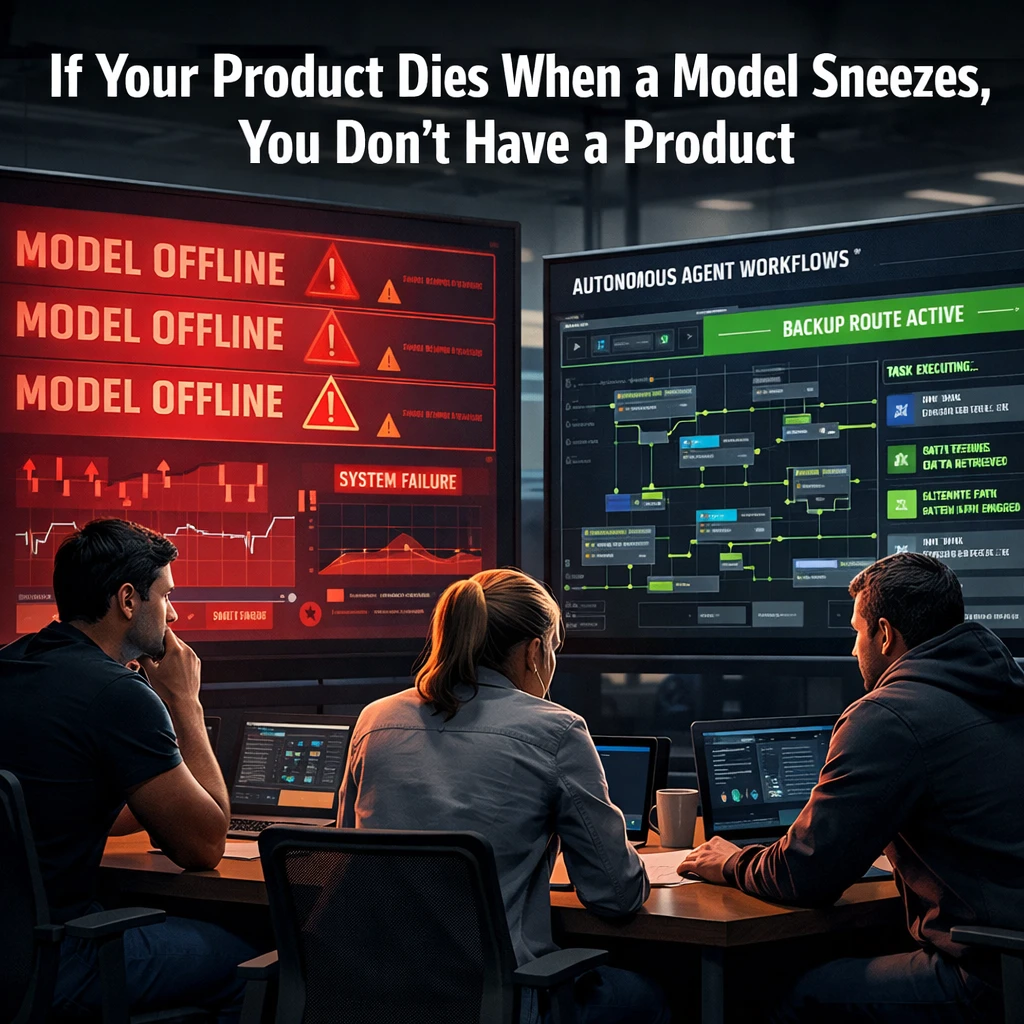


The recent issues faced by Anthropic highlight the risks of relying on a single AI model for product functionality. With the launch of Claude Sonnet 5, which offers significant improvements, founders are cautioned to reconsider their dependence on vendor-specific technology and geopolitical factors that could jeopardize their products.
To mitigate risks, founders should shift their product design to treat models as underlying infrastructure rather than central features. This involves creating robust UX that accommodates model volatility, ensuring transparent user experiences, and integrating fallback mechanisms to maintain operational continuity.
Let’s be blunt: if a single model update or export memo can crater your product, you don’t have a product—you have an expensive UI wrapped around someone else’s brain.
Over the last days, Anthropic’s saga made that painfully clear. After weeks of export controls on its Fable 5 and Mythos 5 models, restrictions were lifted and access is being restored, right as the company launched Claude Sonnet 5 on June 30 as its “most agentic Sonnet yet.” Sonnet 5 ships with major upgrades in coding, tool use, reasoning, and knowledge work, positioned close to Opus 4.8 performance at much lower API pricing—and it’s now the default model for Free and Pro plans.
On paper, that’s fantastic: near–frontier capability at discount prices, plus your favorite agent stack suddenly smarter. In practice, founders should be hearing a different message: “Your whole product depends on one vendor’s roadmapping, pricing, and geopolitics. Are you architected for that reality, or just hoping it stays cheap and online?”
What Actually Happened
Export controls imposed on June 12 forced Anthropic to suspend access to Fable 5 and Mythos 5, disrupting teams using those models for production agents. Late June brought partial relief, and by June 30 Anthropic announced the lifting of controls and the redeployment of Fable 5 and Mythos 5, alongside the launch of Claude Sonnet 5 as a more agentic default model with aggressive introductory pricing.
Translated from PR to founder language: one government decision temporarily broke key capabilities; now a cheaper, more powerful model is dangling as a tempting “upgrade” to rebuild everything on… again.
If your roadmap response was “Cool, let’s lock the whole product onto Sonnet 5 and call it a day,” you’re missing the plot.
Why This Matters More Than “Better Reasoning”
The real story isn’t that Sonnet 5 gets closer to Opus at a lower price. It’s that models are now agentic, default, and centrally governed—in other words, they’re infrastructure with real political and regulatory risk baked in. At the same time, industry practice is shifting from isolated copilots to coordinated agents across the SDLC and workflows, not just one-off prompts.
That combination is deadly for lazy UX:
- Your “assistant” isn’t a cute side feature anymore; it’s orchestrating real work, with autonomy and side effects.
- Your vendor can change latency, behavior, or legal exposure overnight.
- Your users don’t care which model you picked; they care whether the workflow still works, and whether they can trust what just happened.
If you’ve designed UX around the illusion that the model is always fast, cheap, and available, Sonnet 5’s launch plus the export drama should be a hard reset.
What Founders Need to Change in Product and UX
When models become agentic infrastructure, UX must become an operational console, not a magic text box. Agentic SDLC discussions already treat AI as a coordinated set of agents across planning, coding, testing, and delivery, with autonomous testing acting as a validation layer. Your product should mirror that discipline.
Concretely:
- Treat the model as an implementation detail, not the hero. The hero is the workflow you own: claims processing, threat triage, journalist pipelines, onboarding, whatever your product actually controls.
- Make agent behavior legible. Users should see queues, states, approvals, audit trails, and failure modes—not “something happened, trust us.”
- Design for model volatility. Latency spikes, capability changes, or outright downtime must have visible, user-respecting fallbacks built into the UX.
This is exactly the architecture-first approach Poplab formalized in the Agentic UX & Copilot Blueprint: mapping where agents belong, defining decision models, and designing reversible, observable flows before anyone ships “AI mode” into production.Services.
One Concrete Takeaway: Run a Model Dependency Fire Drill
Here’s the exercise to run this week, before you refactor anything for Sonnet 5:
- List every workflow that silently assumes “the model works.”
Include onboarding, key dashboards, notifications, and any agent that touches serious data or money. Mark where a failed call currently looks like “nothing happened” from the user’s perspective. - Design explicit failure and fallback UX for each point.
Decide how the product behaves if the primary model is slow, wrong, or unavailable: queues that pause work, a “manual review” lane, degraded-but-honest modes, and transparent status messages. Make these surfaces first-class UI, not error tooltips. - Abstract the agent layer behind a stable UX contract.
Architect your product so swapping models, adding a second vendor, or re-routing certain workflows to cheaper or more robust stacks does not change the UX contract: what users see, what they can override, and how they recover when AI misbehaves.
Do that, and Claude Sonnet 5 becomes what it should be: a powerful option behind your product, not the single point of failure your entire UX hangs from. Ignore it, and the next export memo—or price hike, or rate limit—won’t just hit your infra. It will hit activation, retention, and trust, precisely where you can least afford surprises.

Leave a Reply