
Background
AI VentureFactory didn’t start as “another AI copilot.” It started as a radical question: what if founders could run the entire company — from idea to exit — inside one self-driving operating system, and leave AI to handle the planning, scaffolding, and a big chunk of the execution overhead that normally eats their week?
LettsGroup set out to build exactly that: an AI-native venture operating system that compresses the full arc of startup building into a single, guided, software-driven experience. Founders log in, answer a few sharp prompts, and within 30 minutes they have a company snapshot, market analysis, roadmap, venture narrative, and a concrete “next 7 days” plan — all tied together by the same underlying model.
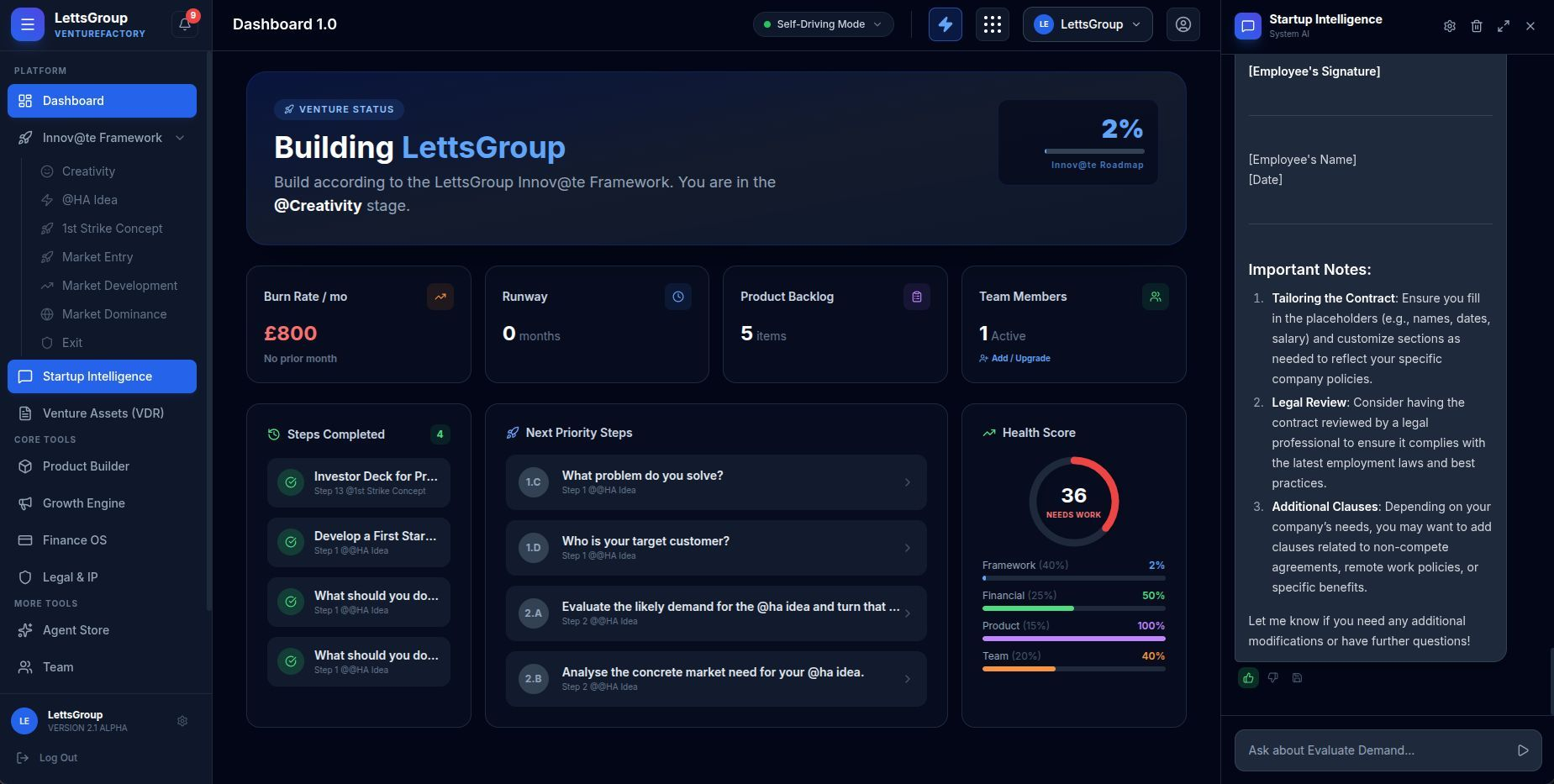
LettsGroup itself is an AI venture group that combines decades of incubation experience with a new AI-first product engine. AI VentureFactory is its flagship platform: “The Map” (Innov@te Framework), “The Sat Nav” (Startup Intelligence), and “The Crew” (AI Co-Founders) wired together into one connected system.
Under the hood, the platform spans a dozen-plus feature areas: Product Builder, Growth Engine, Finance OS, Legal & IP Shield, FundRaiser, Venture Assets and Virtual Data Room, and an AI Agent Store that orchestrates agentic workflows across the entire venture. Each of those could be its own product. Here, they have to behave like one coherent operating system. That’s the design problem Poplab was brought in to solve.
Challenge
The hardest part wasn’t the UI. It was scope.
AI VentureFactory needed to do all of this simultaneously:
- Make a platform with 100+ AI-powered tools feel focused, not sprawling.
- Let founders move between planning, execution, finance, legal, fundraising, and product without feeling like they’re switching apps.
- Build trust in agentic workflows where AI doesn’t just suggest, but acts — changing venture data, updating plans, triggering tasks, and rewriting narratives.
- Design plan-gated features so pricing tiers are clear, but the UX doesn’t turn into a wall of “upgrade” modals.
- Turn a complex methodology (Innov@te Framework + Startup Intelligence) into a navigation model founders can grok in minutes, not hours.
Layered on top: multi-model orchestration, AI confidence scoring, latency, error states, and “why did it do that?” moments that traditional SaaS patterns don’t handle well. The product’s core risk wasn’t that AI would fail — it was that founders wouldn’t understand what it did, or why.
Process
Poplab built AI VentureFactory the way AI products should be built now: design-led, systems-first, and aggressively AI-augmented.
Information architecture via LLM synthesis
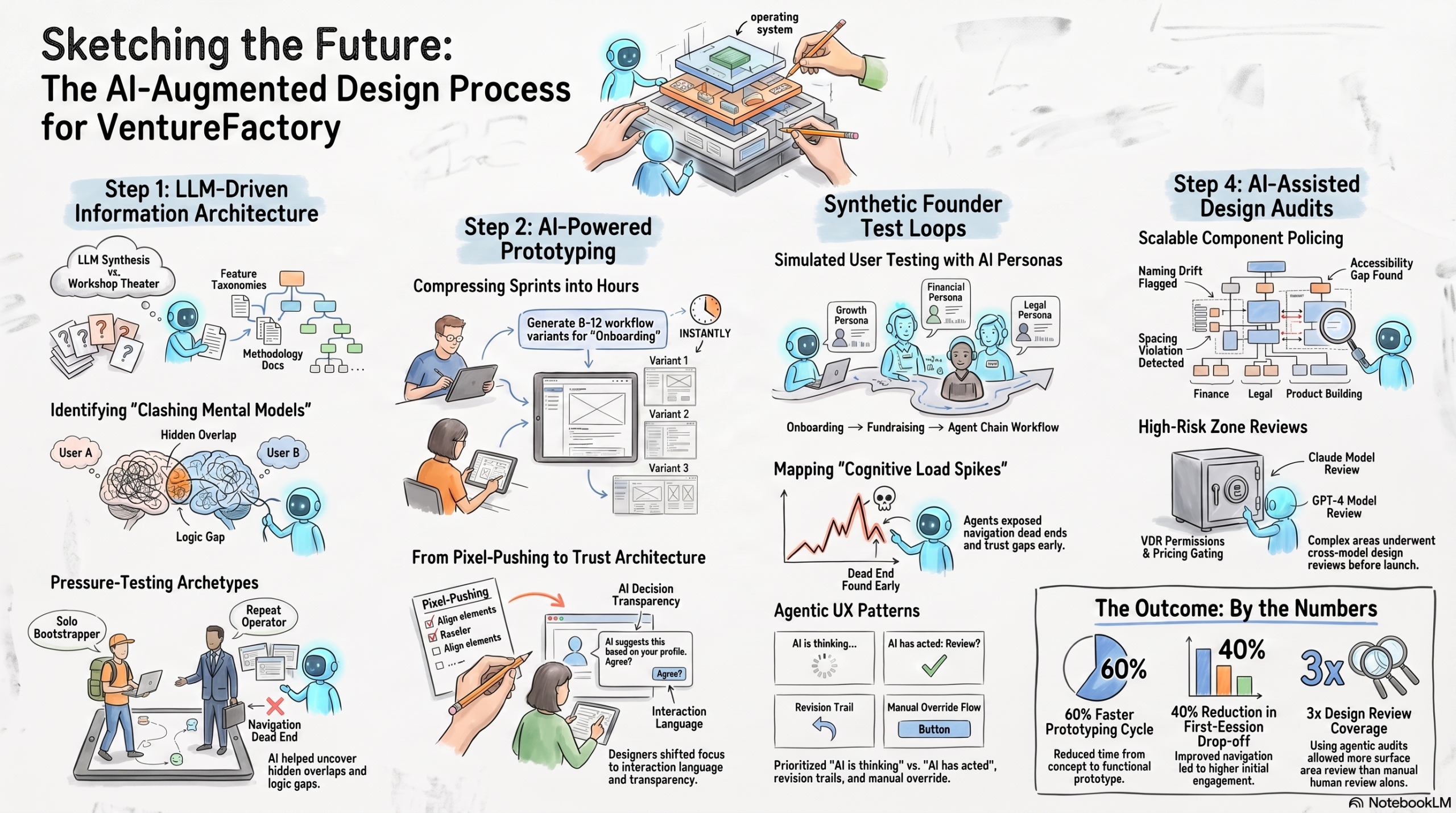
Instead of running weeks of card sorting and workshop theater, we fed the full feature taxonomy, LettsGroup’s methodology documents, and competitive venture-building platforms into structured multi-model review loops. LLMs surfaced natural groupings, clashing mental models, and hidden overlaps that would have taken weeks to uncover manually.
We then pressure-tested those candidate architectures against founder archetypes — first-time technical founders, repeat operators, solo bootstrappers — before committing to a navigation model. The output: a hierarchy where founders can move between planning, operating, and executing layers without losing context.
AI-powered prototyping instead of manual layout grind
First-pass layouts were generated using v0.dev and Figma AI from natural language briefs tied to specific workflows (e.g., “fundraising overview with confidence indicators and next actions,” “VDR permissions for multi-founder teams”). We intentionally explored 8–12 layout variants per key screen, compressing what used to be a full sprint into hours.
This wasn’t about replacing design craft. It was about compressing the drudge work so more time could be spent on what actually matters: mental models, interaction language, and trust architecture.
Synthetic founders and agentic UX test loops
Before a single real founder touched the product, we built a synthetic cohort of AI-driven personas reflecting core venture types and ran them through simulated onboarding, VDR creation, Agent Chain setup, fundraising workflows, and plan upgrade moments.
These agents exposed navigation dead ends, cognitive load spikes, and trust gaps early — letting us fix them in design, not in production. Agentic UX patterns (confirmations, revision trails, “AI is thinking” vs. “AI has acted,” override flows) were treated as first-class design problems, not post-launch band-aids.
AI-assisted design audits across a massive surface area
With 14+ feature categories, manual component policing would have guaranteed inconsistency. We ran AI-based design audits at each milestone to flag naming drift, spacing violations, accessibility gaps, and UX edge cases. High-risk zones like VDR permissions, Agent Chain triggers, pricing and plan gating, and fundraising workflows went through cross-model design review before user testing.
The design system itself was seeded using AI-derived color scales based on LettsGroup’s brand DNA, typography tuned to a data-heavy dashboard context, and spacing tokens optimized around density and legibility.
Solution
The result is an experience where a very complex product feels surprisingly calm.
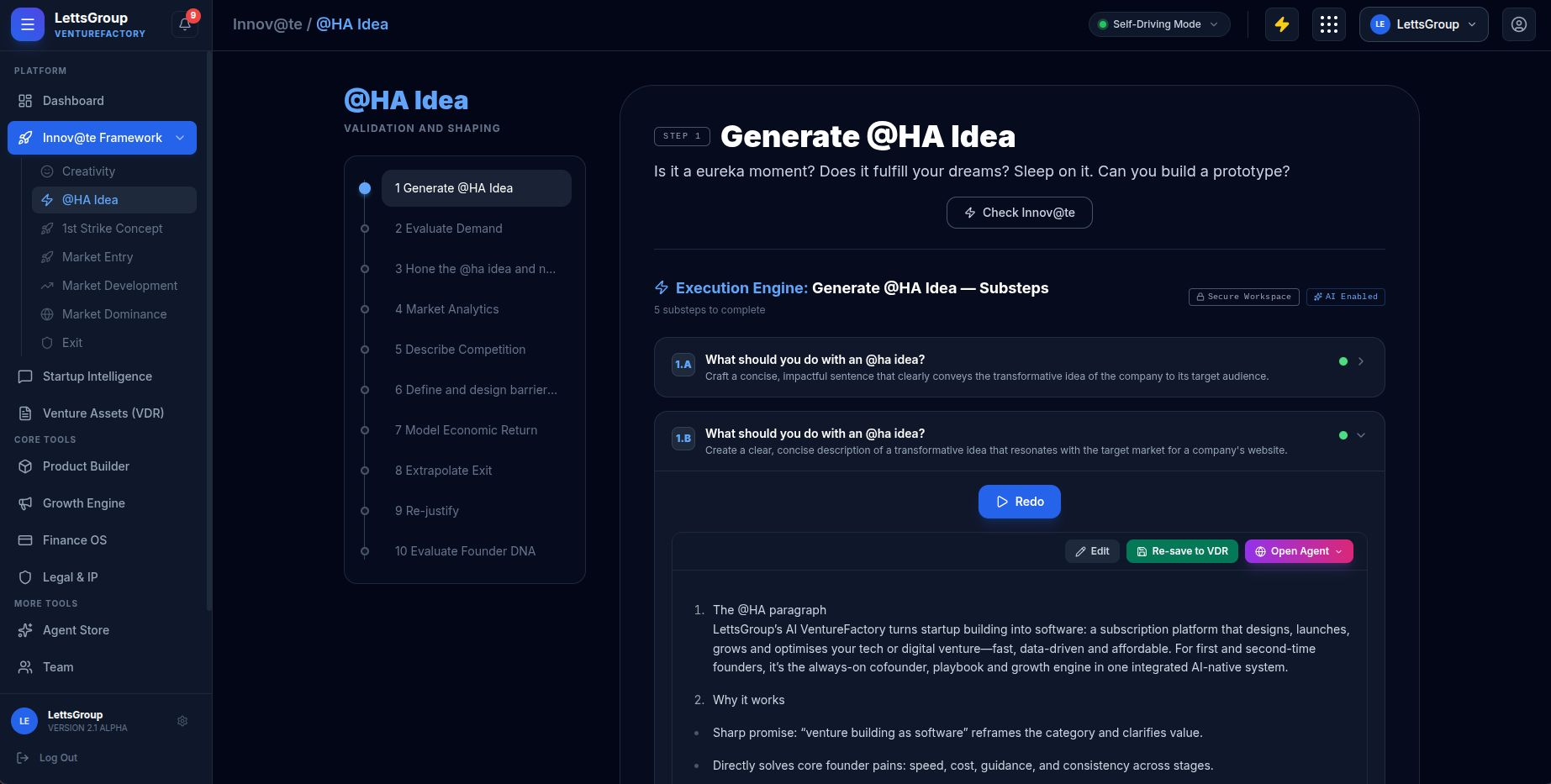
The information architecture organizes AI VentureFactory into clear, layered zones:
- Innov@te Framework (“The Map”) — structured venture roadmap including idea, market, product, traction, funding, and exit arcs.
- Startup Intelligence (“The Sat Nav”) — live, chat-style guidance that scores venture health, calls out risks, and recommends next best actions.
- AI Co-Founders (“The Crew”) — targeted agents that execute plans across Product Builder, Growth Engine, Finance OS, Legal & IP, FundRaiser, and Venture Assets.
Founders move between strategy, execution, and operating layers without feeling like they’re falling into a different app. The Agent Store presents 100+ tools in a way that rewards exploration without flooding the user with options. The Virtual Data Room feels like a serious workspace — permissions, encryption, document structure — not a glorified upload drawer.
Every agentic interaction follows a clear pattern: status states that differentiate “AI is processing” vs. “AI has acted,” revision trails that show what changed and why, and simple controls that let founders dial autonomy up or down without hunting.
Startup Intelligence surfaces confidence levels and rationale instead of opaque scores. When AI updates a plan, rewrites a narrative, or adjusts a roadmap, the platform shows exactly what shifted. This transparency is the product — not a nice-to-have.
Pricing tiers are woven into the UX as contextual capability previews. Founders see what’s possible at the next tier exactly when they hit the boundary — with clear value framing, not nagging banners. This cut the “upgrade fatigue” that plagues most SaaS pricing UX, while boosting the likelihood that upgrades happen at moments of genuine intent.
Outcomes by the Numbers
~60%
Faster design-to-prototype cycle AI-native tooling
~40%
Reduction in first-session drop-off
2.4x
Task discoverability Agent Store navigation
~35%
Increase in plan upgrade conversion contextual capability previews
~50%
Fewer navigation errors
agentic workflow screens
~30%
Increase in VDR feature adoption within first week of use
3x
Design review coverage
agentic audit vs. manual review
~25%
Reduction in support-driven UX queries post-launch
Figures represent directional improvements observed or targeted across representative cohorts and design validation cycles. Individual results will vary.
Learning
This project confirmed a hard truth: designing for agentic AI is not the same discipline as designing for traditional software. Teams that treat it like “just another feature” ship experiences that confuse users, erode trust, and cap adoption before the model even gets a chance to shine.
Founders aren’t afraid of AI doing work. They’re afraid of not understanding what it did. Every trust-building pattern — transparency, revision trails, clear scope boundaries, legible automation — paid back directly in engagement and conversion. AI-native workflows didn’t reduce design depth; they changed where the depth lives, freeing more cycles to design mental models, agent architecture, and decision pathways instead of pushing pixels.
My Contribution
Poplab joined AI VentureFactory as the founding design partner. On this project, my role included:
- Defining the venture-wide information model and navigation hierarchy.
- Architecting the agentic UX framework across Startup Intelligence, AI Co-Founders, and the Agent Store.
- Leading the prompt-to-prototype pipeline using v0.dev, Figma AI, and Lovable to explore solution spaces fast.
- Building the design system and component library tuned for a dense, data-heavy venture dashboard.
- Running synthetic usability testing with LLM agents and integrating multi-model design review (Claude, GPT-4) into the critique loop.
The outcome: a venture operating system that lets founders run the full arc of company building in one place — with AI doing more of the heavy lifting, but never at the expense of human judgment.