
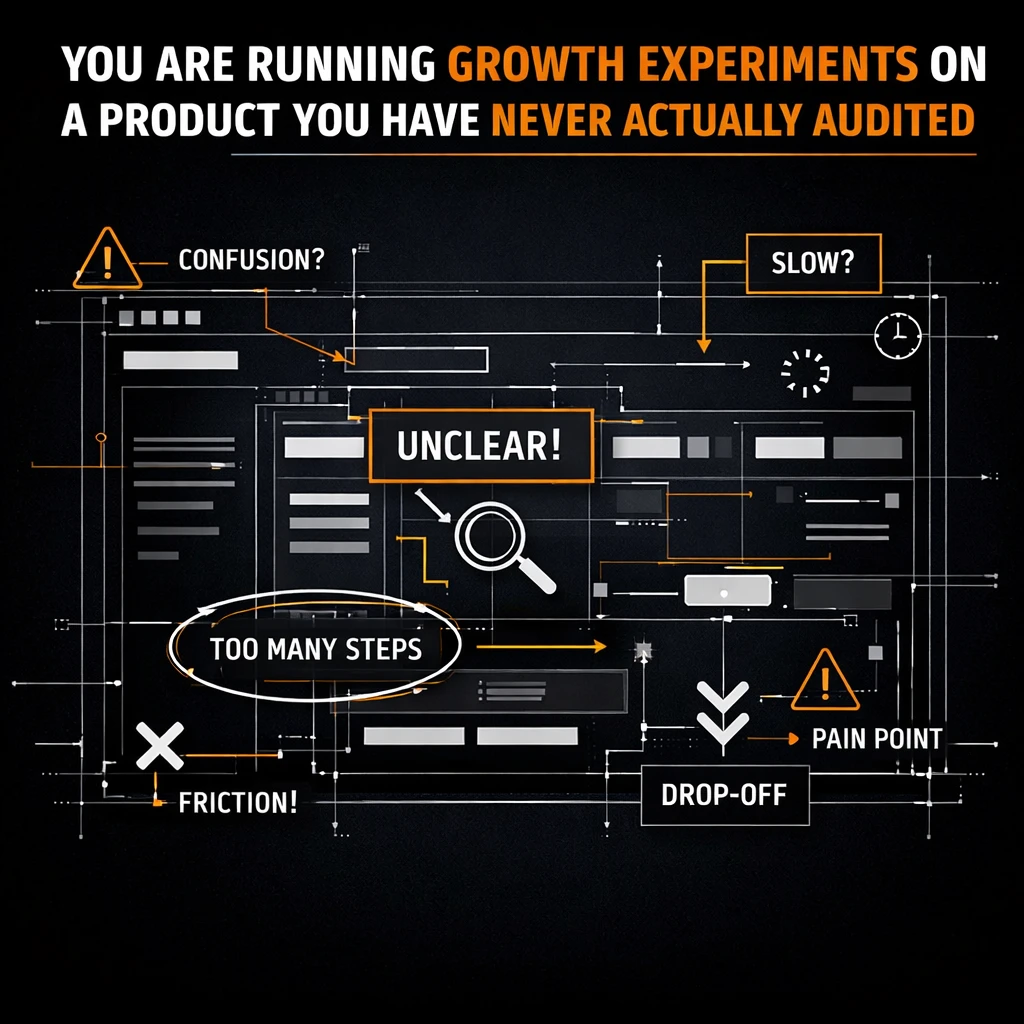


Understanding where a product loses users is crucial for effective growth strategies. Many AI startups lack a structured, evidence-based analysis of user experience, relying instead on inadequate feedback methods. This oversight leads to scaling inefficiencies rather than addressing underlying friction points.
A formal design audit can uncover hidden product issues that negatively impact conversion and activation rates. By prioritizing specific problem areas through an annotated friction map, teams gain clarity on necessary improvements. Watching user session recordings can also help identify critical friction clusters to address before investing further in acquisition efforts.
Before you run another growth experiment, answer one question honestly: do you actually know where your product is losing people, and why?
Not from intuition. Not from a support ticket someone filed three months ago. From a structured, evidence-based examination of the flows your users move through every day — annotated, prioritized, and specific enough to act on.
Most AI startup teams cannot answer that question. They have analytics. They have session recordings they have not watched. They have a backlog of UX improvements that never make it past the roadmap discussion because nobody has made the case with enough precision to displace a feature request. And so they keep running acquisition campaigns, onboarding experiments, and retention pushes on top of a product foundation they have never formally examined.
That is not a growth strategy. That is scaling friction.
What You Are Missing Without a Formal Audit
There is a class of product problem that never surfaces in normal operations. It does not generate support tickets because users do not know how to describe it. It does not show up in NPS comments because the friction is ambient rather than acute. It does not appear in feature request logs because users have already adapted their behavior around it rather than demanding it be fixed.
These are the problems that silently determine your conversion rate, your activation rate, and the percentage of users who reach the core value of your product before they stop trying. They live in microcopy that creates doubt at a critical decision point. In an empty state that stops a new user cold instead of directing them forward. In a navigation pattern that made sense to the engineer who built it and makes no sense to the user encountering it for the first time.
A design audit surfaces all of this. Not as a list of subjective observations, but as an annotated friction map — specific screens, specific moments, specific fixes ranked by impact — that gives your team an unambiguous starting point for what to address first.
Why Founders Avoid It and Why That Is Backwards
The most common reason founders skip a formal design audit is that it feels like a backward step — a diagnostic exercise when what the business needs is forward momentum. That logic inverts the actual risk. The cost of auditing a product that turns out to be in good shape is low. The cost of scaling a product with undiagnosed UX failures is compounding and expensive, because every user you acquire encounters the same friction and every dollar you spend on growth hits the same conversion ceiling.
An audit does not slow momentum. It prevents you from building momentum in the wrong direction.
There is also a blind spot problem. The longer a team has been inside a product, the less they can see the experience a first-time user actually has. Founders stop noticing friction because they have long since learned to navigate around it. The users who encounter it for the first time and leave do not send an explanation. They just do not come back.
One Thing You Can Do Before You Spend Another Dollar on Acquisition
Pick the single most important conversion event in your product — the moment that separates an activated user from someone who bounced — and watch five session recordings of users who did not reach it. Do not interpret. Do not explain away what you see. Just watch where they slow down, where they click on things that do not respond the way they expected, and where they stop.
Whatever you observe in those five recordings is your highest-priority friction cluster. It is costing you conversion on every user who hits it. And it almost certainly exists in other flows you have not looked at yet.
Poplab’s Design Audit delivers a complete annotated friction map, a UX and copy scan, and a prioritized fix backlog with a Loom walkthrough — in two to seven business days, from $499.
It is the fastest diagnostic available before your next growth push.
Book a free strategy call and get started within 24 hours.

Leave a Reply