
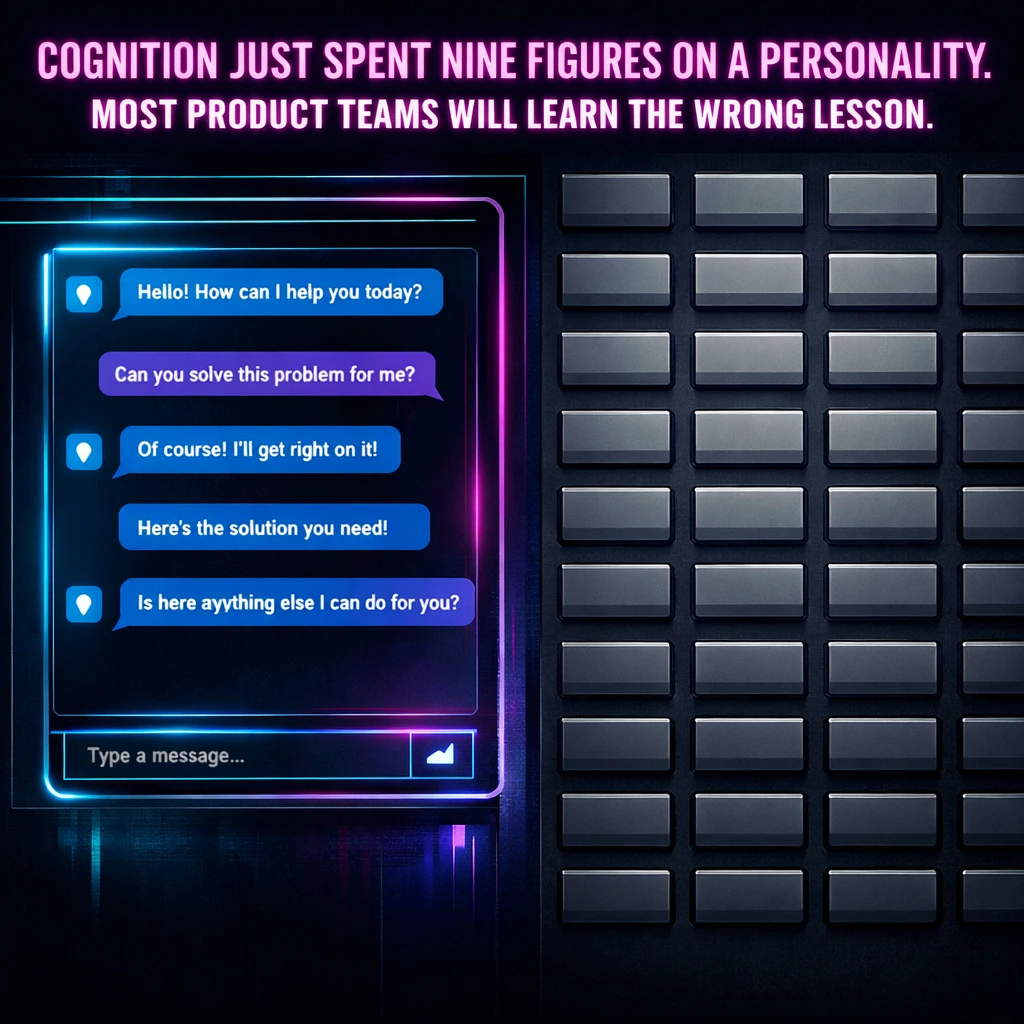

Cognition acquired Poke, maker of an AI assistant, for a nine-figure sum to make its Devin agent feel like a colleague. The acquisition highlights that interaction quality is real product work, but the lesson isn’t adding jokes or personality toggles. Poke’s value lay in its interaction model.
Most enterprise products fail at interaction, not personality. They show silence in errors, empty states, and loading screens. Honesty—explaining what happened, what it means, and what to do next—is the actual value. Teams should audit their product’s out-of-happy-path strings to fix these leaks.
This week, Cognition — the company behind Devin, the autonomous coding agent — spent somewhere in the low nine figures to buy a personality. It acquired The Interaction Company of California, maker of Poke, the AI assistant you text like a friend. The stated goal: make Devin feel less like software and more like a colleague.
The market has now put a nine-figure price tag on how a product talks to its users. That should end a decade-long argument inside B2B SaaS product teams about whether tone, voice, and interaction quality are “real” product work or brand decoration. They are real. Someone just paid for them.
But most product teams are about to learn the wrong lesson.
The wrong lesson is that you need to add jokes to your product. The wrong lesson is a settings toggle called “personality” that injects slang and emoji into your error messages. The wrong lesson is a marketing rewrite of your copy deck. All of that is still fluff. It is design theater with a new name.
What Poke actually did well was not humor. It was the interaction model. Poke is proactive. It confirms what it understood before acting. It remembers context across conversations. It tells you what it can and cannot do, and it recovers cleanly when it gets something wrong. That is what “feels like a colleague” means. A good colleague is not funny. A good colleague is clear, honest, and responsive to your actual state.
Scott Wu, Cognition’s co-founder, said it directly: Poke is “proactive, it knows you, and it’s fun to talk to.” Notice the order. Proactive first. Knows you second. Fun third. The fun is the smallest part of what made the product worth acquiring.
Here is the uncomfortable part for B2B SaaS. Most enterprise products do not fail at personality. They fail at the interaction model. Their error messages say “An unexpected error occurred.” Their empty states say nothing. Their loading screens give no indication of how long anything will take or what is happening. When the product is confused, it goes silent. When the user is confused, there is no hand to guide them. The product does not confirm what it understood, does not explain what it is about to do, and does not tell the user what happens next.
That silence is a product leak. It is churn wearing an interface.
Personality is not the opposite of silence. Honesty is. The companies that will build products people actually want to work with are the ones that design every conversational moment — the confirmations, the failure states, the uncertainty, the waiting — with the same care they give the happy path. That is where the nine figures of value actually lives.
One action you can take this week: pull every string your product shows a user outside the happy path. The error messages, the empty states, the loading screens, the “something went wrong” fallbacks, the confirmations. Ask one question of each: does this tell the user what happened, what it means, and what to do next? If the answer is no, that string is a leak. Most products will fail the audit on more than half of them.
At Poplab, a design audit catches exactly this — the interaction layer most product teams never look at because it does not show up in a feature roadmap. Cognition just proved it is worth real money. The teams that fix it before their competitors do will be the ones users describe as “good to work with.”

Leave a Reply