
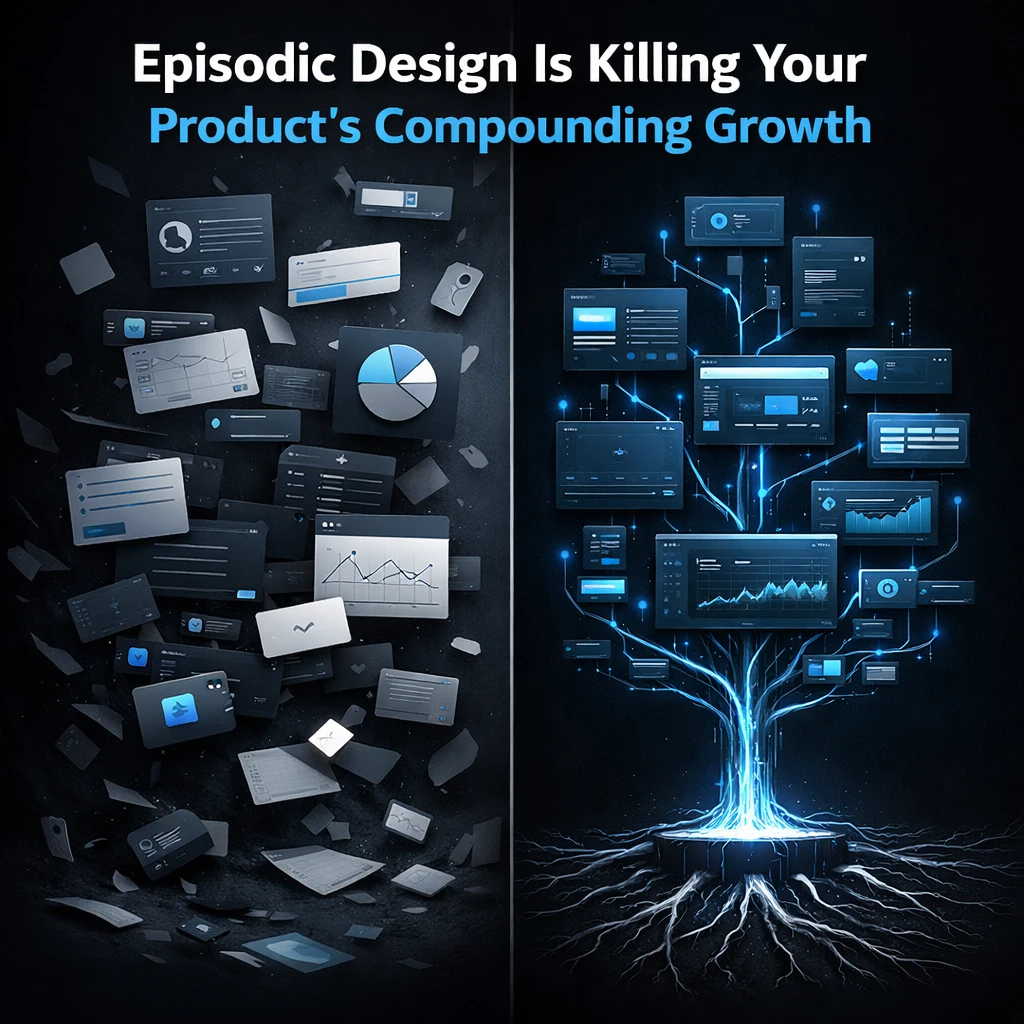


AI startups often face structural issues in design as they grow. They typically engage designers project-by-project instead of hiring a full-time senior designer, leading to product incoherence over time. This lack of continuity can result in a product that feels inconsistent and less trustworthy, affecting user retention and enterprise evaluations.
Continuity in design is crucial for maintaining quality and context. An embedded design partner can provide deeper insights and faster decision-making, reducing delays and enhancing design coherence. The retainer model becomes beneficial once design decisions happen frequently enough, helping to mitigate the costs associated with inconsistent design and slower engineering velocity.
Every AI startup eventually hits the same structural problem with design: they have shipped enough product that one-off sprints no longer cover the surface area, but they are not yet at the scale where a full-time senior designer hire makes clean financial sense. So they do what feels pragmatic — they bring in designers project by project, brief them each time from scratch, and move on.
The product that results from this approach is not bad in any single moment. It is incoherent over time. And product incoherence, compounding across six months of episodic design decisions, is one of the most expensive quality problems a scaling startup can carry.
What Gets Lost Between Sprints
The thing that erodes fastest in episodic design is context. Every time a new designer or agency touches your product without deep familiarity with what came before, decisions get made in isolation. A new component gets built that slightly contradicts an existing pattern. A flow gets redesigned without accounting for a downstream dependency. A visual direction gets introduced that works in isolation and creates inconsistency at scale.
None of these decisions are wrong on their own terms. The designer made the best call they could with the information available. The problem is structural: they did not have the full picture, because no single person outside the founding team has been consistently inside the product long enough to hold it.
The result is a product that experienced users feel before they can name — something slightly off, slightly inconsistent, slightly less trustworthy than it should be at this stage. That feeling has a commercial consequence. It shows up in enterprise evaluations where procurement teams are looking for signals of product maturity. It shows up in retention data where users disengage not because the product failed them but because it never quite cohered into something they trusted fully.
The Compounding Argument for Continuity
Design quality compounds when a single partner holds the full context of a product over time — the decisions made, the tradeoffs accepted, the patterns that work and the ones that were tried and discarded. That accumulated context is not transferable in a project brief. It has to be lived.
An embedded design partner operating on a retainer knows which components are stable and which are fragile. They know where the design system has gaps before a new feature exposes them. They know the product well enough to push back on a feature direction that will create downstream UX debt — not because they are being obstructive but because they have seen how the last three similar decisions played out.
That is a different quality of design input than any sprint can produce, regardless of how talented the sprint team is. It is also a faster quality of input. A partner who knows your product deeply does not need two days of onboarding before they can make a useful decision. They are already in context. That speed compounds across every sprint, every weekly call, every design review where the right answer arrives in minutes rather than days.
When the Retainer Model Makes Commercial Sense
The retainer model earns its cost when design decisions are being made frequently enough that the overhead of briefing and re-briefing project teams is itself a meaningful drag on velocity. That threshold is lower than most founders expect — typically somewhere around the point where product changes are happening weekly and design is consistently on the critical path for engineering.
At that point, the comparison is not retainer versus sprint. It is retainer versus the accumulated cost of slower decisions, inconsistent quality, and the recurring overhead of bringing external teams up to speed on a product that is moving faster than any brief can capture.
One Thing You Can Do This Week
Count the number of times in the last month that a product or engineering decision was delayed, reversed, or complicated because there was no designer with full context available to weigh in quickly. If that number is more than two, you are already paying the cost of episodic design in engineering velocity and product quality. The question is whether you are paying it visibly or invisibly.
Poplab’s Retainer Partnership gives you an embedded design partner at $1,500 per month: priority sprints, weekly strategy, and a scope built around your growth targets — not a fixed deliverable list that does not match where the product actually is.
Book a free strategy call and get a custom scope proposal within 24 hours.

Leave a Reply