
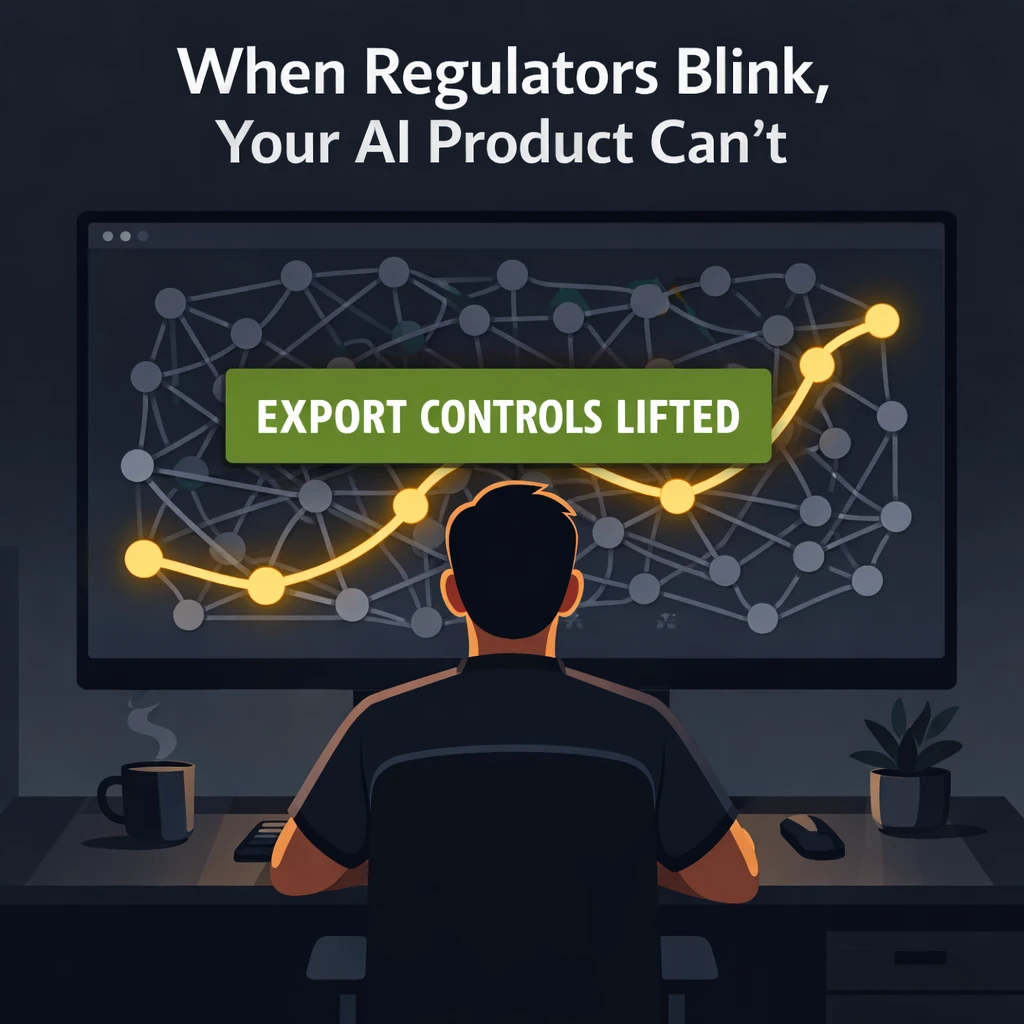

A recent decision by the U.S. Department of Commerce has lifted export controls on Anthropic’s models, restoring user access after weeks of disruption. This change highlights the dependency risks in AI products, emphasizing that access to AI is influenced by political variables, which can impact user experience.
AI startups are urged to assess their products for resilience against model unavailability. Key considerations include ensuring workflows remain functional under constraints, providing clear user communication during outages, and establishing boundaries for AI operations. The ultimate goal is to design products that acknowledge AI volatility as a component, rather than a reliance, fostering trust and robustness amidst regulatory fluctuations.
Let’s be blunt: if a single government decision can quietly break your product, you don’t have an AI strategy—you have a dependency problem.
This week, Anthropic said the U.S. Department of Commerce has lifted export controls on its Fable 5 and Mythos 5 models, with user access being restored after weeks of disruption. In the same breath, those models—and the broader Claude family—are rolling deeper into enterprise stacks, including general availability inside Microsoft Foundry on Azure. Translation for founders: the taps on frontier models are back on, and the pipes now run straight into serious infrastructure.
Most reactions I’ve seen from early-stage teams are naive optimism: “Great, the scary part is over, we can ship our agent now.” No. The scary part is the reminder that regulators can turn your stack off between sprints—and your UX isn’t built for that reality.
What actually happened here is simple: a powerful class of models was restricted, causing weeks of friction and uncertainty, then flipped back on with a policy change and a vendor announcement. That’s the new normal if you’re building on top of frontier AI. Access isn’t a constant; it’s a political variable. If your product experience breaks the moment someone in Washington gets nervous, that’s on you, not on Anthropic.
Why does this matter more for UX than for your infra diagram?
Because your users don’t care which foundation model you picked. They care whether the thing they’re trying to do—approve an invoice, clear a security alert, publish an article—actually happens, with clear status, predictable behavior, and a recovery path when the magic fails. The more “agentic” your product is, the more your interface becomes a risk surface: opaque automation, silent failures, and unexplained decisions are where trust dies, not in the model card.
Regulators lifting export controls is a useful stress test: it exposes how many products have zero notion of graceful degradation. No status language for “AI is temporarily constrained.” No fallback flows. No scoped behavior when the model is weaker, slower, or temporarily replaced. Just a loading spinner and a prayer.
If you’re building an AI startup right now, treat this moment as a design audit on your dependence on “perfect access”:
- Does your most important workflow still work—maybe slower, maybe more manual—if your primary model is unavailable or throttled?
- Does the UI tell users what’s happening in plain language when the AI can’t act at full power?
- Do you have clear boundaries on what the AI is allowed to touch when confidence or capabilities drop, or is it still free to wander through billing, security, and comms?
If the honest answer is “we’d just show an error and hope they try again,” you’re not building a product; you’re running a demo.
The upside of this week’s news is clear: more access to strong models, more enterprise-grade routes via platforms like Azure, and fewer artificial walls for teams outside the U.S. The downside is the illusion that the governance risk is gone. It isn’t. It just moved up a layer, from “can I call Fable 5?” to “what happens to my users when I suddenly can’t?”
One practical move you can make before your next sprint planning: run a “model outage rehearsal” on your most important workflow. In staging, deliberately rate-limit or disable your primary model, then watch where the UX collapses—approval queues that freeze, onboarding flows that dead-end, dashboards that silently show stale data. Design an explicit degraded mode: tighter scope, clearer messaging (“We’re running in safe mode; here’s what that means”), and a human-overridden path for high-stakes actions.
Then ship just one trust-and-resilience improvement per cycle: a better status pattern, an undo, a manual override surface, or a non-AI fallback on the most consequential screen. Don’t wait for another export-control surprise to force the refactor
At Poplab, this is exactly where agentic UX and copilot work live: designing the control layer—states, guardrails, observability, and failure modes—so founders aren’t hostage to someone else’s API or policy mood swings. Whether you do it with us or in-house, the bar is the same: your product should behave like it expects AI volatility, not like it never imagined it.
Regulators will keep blinking. Models will keep shifting. The only durable moat you have is a product that treats powerful AI as a component, not a crutch. Fix that, and the next export-control headline becomes a minor UX update—not a company-threatening incident.

Leave a Reply