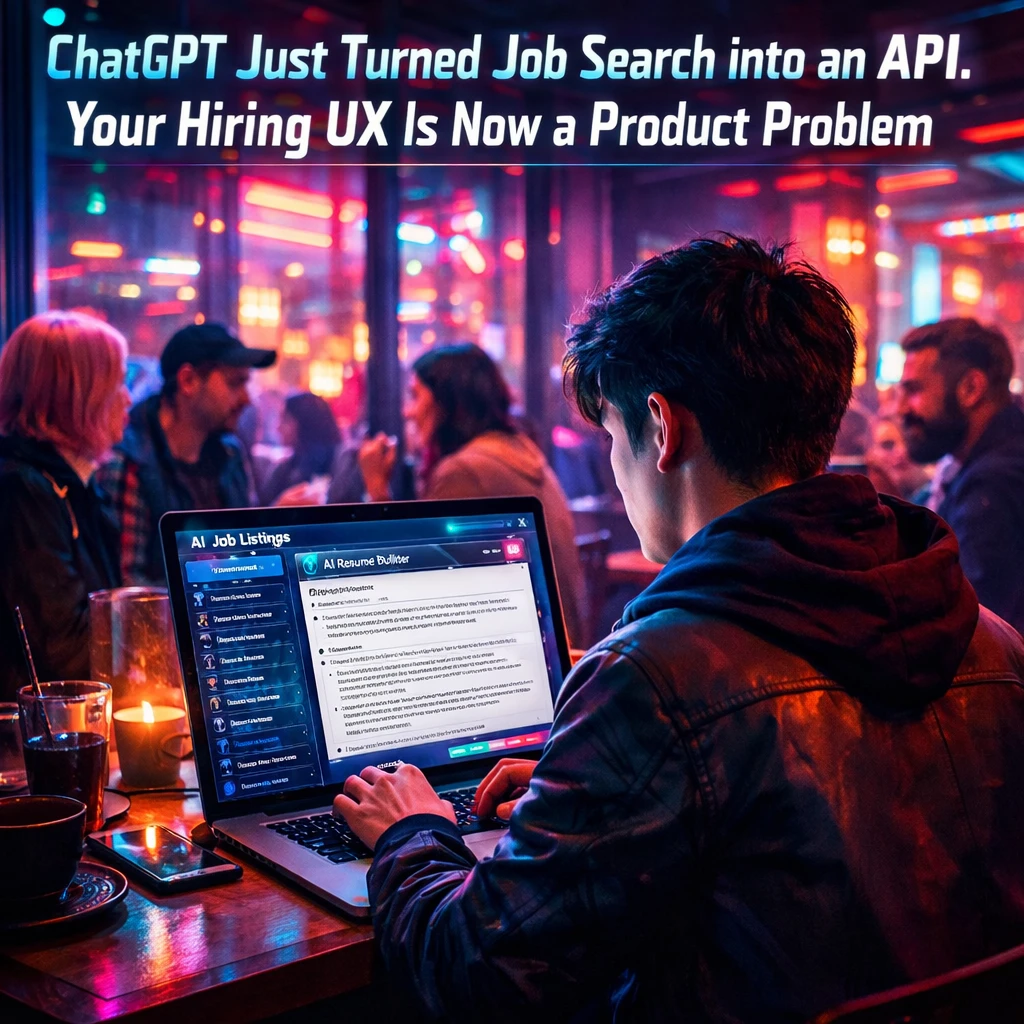

Job boards have evolved, integrating with AI tools like ChatGPT that streamline the job search and application process. OpenAI’s recent features enable users to search live job listings and create tailored resumes within ChatGPT, fundamentally changing the way candidates interact with potential employers.
For AI startups, this shift means reconsidering hiring as a product design challenge rather than an HR task. To capture talent effectively, companies must ensure their job descriptions are clear and machine-friendly, while also simplifying the application process to meet the heightened expectations of candidates using AI tools.
Let’s be blunt: job boards didn’t die—they just got absorbed. When ChatGPT can find candidates live roles and rewrite their resumes in the same interface, your “Careers” page is no longer the front door. It’s a backend API.
On June 1, OpenAI rolled out job search and resume tooling directly inside ChatGPT: users can search live listings from sources like Indeed, Upwork, Appcast and the broader web, then tailor and export a polished resume for specific roles, all without leaving the chat. Job search is available in the US across all plans; resume formatting is live globally in English on the web.
This is not a cute feature; it’s a distribution reset for talent. And AI startups who still treat hiring as “post a JD on LinkedIn and hope” are about to get quietly out‑recruited.
What Actually Changed This Week
Two important shifts landed in one release:
- Discovery moved into ChatGPT. Candidates can now ask “find senior product designers at AI startups in Europe” and get live roles from multiple platforms in a single, personalized list. They’re not starting on your site; they’re starting with an intent query.
- Craft moved into ChatGPT. The same interface can now generate or adapt a resume to match your role, then export a clean version for upload.
In practice, that means the candidate’s experience of your company is now:
Prompt → AI-curated short list → your job description rendered as a snippet → their AI‑edited resume → your application flow.
You own only two pieces of that chain: the job content and the application UX. Everything else is mediated by an assistant you don’t control.
Why This Matters for AI Startup Founders
For AI-first startups, design and hiring are now the same problem: being legible to an intelligent intermediary. You already have to design your product so AI agents, search wrappers, and operating system assistants can call it. Now you have to design your hiring funnel so career copilots can “call” you too.
Three consequences:
- Your job description is now an API contract.ChatGPT is summarizing and ranking it, not reverently reading your fluffy culture paragraph. Ambiguity, buzzwords, and vague responsibilities translate into weaker matching and lower relevance when candidates filter by skills, seniority, or domain.
- Your employer brand is downstream of your product clarity.If your product positioning is muddy, the JD scraped from your site will be equally incoherent. Poplab’s whole thesis is that founder-first, metric-driven positioning is the starting point for every surface—from hero sections to onboarding. The hiring UX is just another surface.
- Candidate expectations for speed and personalization just spiked.When their “AI recruiter” can find and prep three strong applications in one session, candidates will not tolerate 45-minute forms, generic rejection emails, or unclear next steps.
Treat Your Hiring Funnel Like a Product Surface
If you’re an AI founder, here’s the move: stop treating hiring as HR’s problem and start treating it as product design.
Concrete changes you can ship this week:
- Rewrite your JD like a task, not a brochure.
- Lead with the core mission and the non‑negotiable outcomes for the role.
- Use explicit, machine‑friendly structure: Responsibilities, Required skills, Nice‑to‑haves, Compensation band, Location/remote rules.
- Kill the generic “rockstar / ninja / passionate about innovation” filler—the summarizer will strip it anyway.
- Design the application flow as “first successful intent.”The candidate equivalent of activation is submitting a high-quality application without hating you for it.
- Ditch account creation for first contact.
- Allow “paste LinkedIn URL + upload resume” as a minimum viable application.
- If you need a task, keep it brutally scoped and clearly tied to how you actually work.
- Make your role legible to AI.
- Ensure your job pages are crawlable and not buried behind weird JS or PDF downloads.
- Use precise role titles people actually search for (“Senior Product Designer, AI” beats “Design Generalist”).
- Keep one canonical JD per role; don’t fragment across four different platforms with different wording.
At Poplab, I already see founders putting more rigor into onboarding flows than into hiring flows—which is backwards. The people building your AI product are a higher‑leverage funnel than your free trial users. The same design discipline you’d apply to an onboarding sprint or design system audit should be applied to how great candidates first experience you.
One Takeaway to Act On Now
Run a 48‑hour “hiring UX audit” exactly like you would a product teardown:
- Ask ChatGPT to “find live senior [your role] jobs at AI startups like [you]” and see where—or if—you show up.
- Paste your own JD into ChatGPT and ask it to summarize for a mid‑senior candidate: if the summary doesn’t match what you actually need, rewrite.
- Time your own application flow from “click job link” to “submitted”: if it’s over 10 minutes for a first touch, cut steps.
You don’t control the new job search interface. But you absolutely control whether your startup is legible, attractive, and low‑friction once an AI career copilot routes a candidate your way. Design that on purpose—or watch better teams hire the people you thought you couldn’t afford.

Leave a Reply