
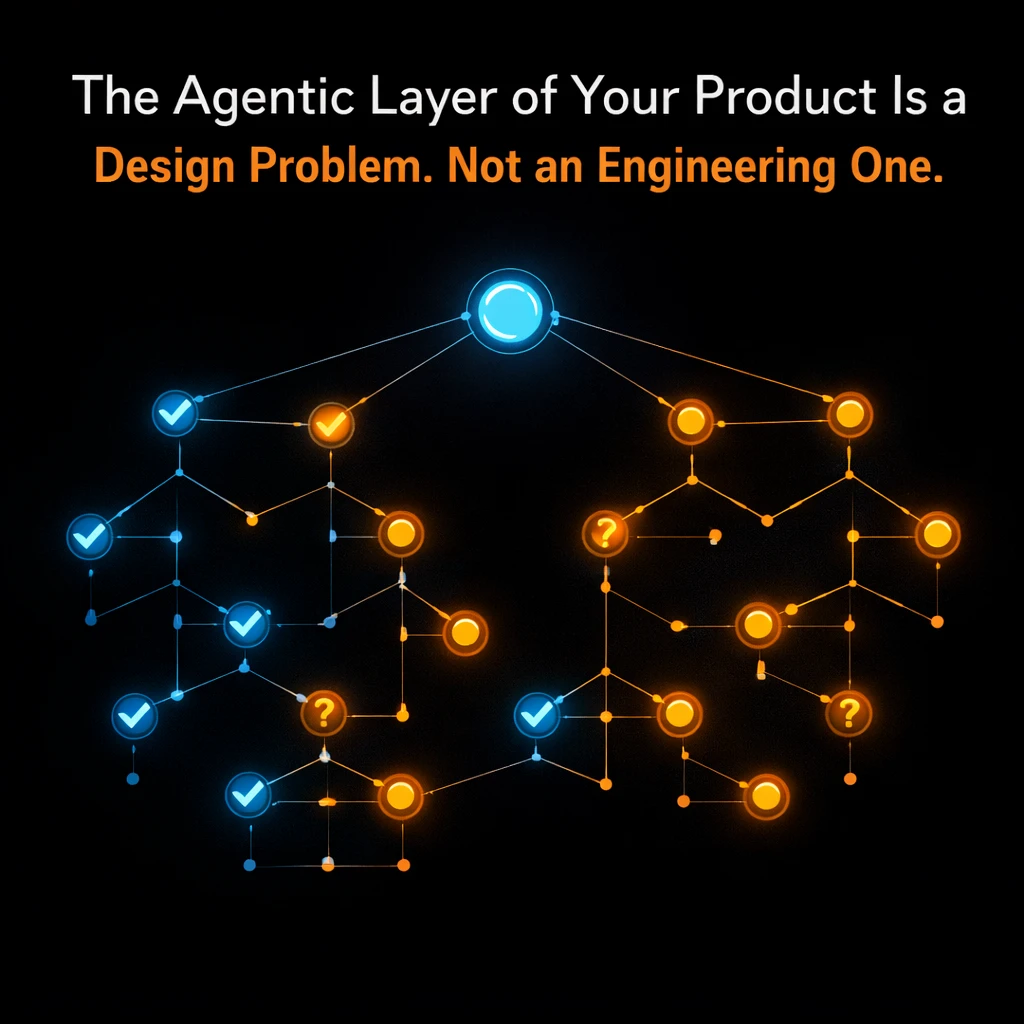


Founders developing agentic AI often overlook the necessity of user-centric design, treating it as a post-engineering concern. This oversight leads to a lack of understanding for users, causing trust issues and product dissatisfaction even when functionality is intact.
Agentic products frequently exhibit a design flaw termed “invisible authority,” where users are unaware of actions taken by the agent on their behalf. This erodes user confidence and complicates procurement decisions in enterprise environments. Effective agentic UX requires clear communication of actions, trust-building features, and user control mechanisms established early in the design process.
Founders building with agentic AI right now are making the same mistake in parallel: they are treating agent design as an engineering problem. Get the model right, wire up the tools, ship the workflow. Design can come later.
It cannot come later. And by the time most teams figure that out, users have already decided the product feels broken — even when it is technically working exactly as intended.
The Agentic Trust Gap
Here is what actually happens when a user encounters an agentic feature that was not designed for human legibility: the agent acts, something changes in the product, and the user has no clear understanding of what happened, why it happened, or whether they should accept it.
That moment — the gap between what the AI did and what the user understood — is where trust collapses. Not in a dramatic, all-at-once way. In the quiet, compounding way that shows up as churn, support tickets, and users who stop enabling your best features entirely.
This is not an edge case. It is the default state of most agentic products shipped in 2025 and 2026. The model works. The orchestration works. The UX does not exist.
Agents That Act Without Explanation Are a Liability
There is a specific design failure mode in agentic products that nobody talks about enough: invisible authority. The agent has permission to act on the user’s behalf — modifying data, triggering workflows, sending outputs — but the user has no visual or interaction model for what the agent is doing, when it is doing it, or how to override it.
The result is not just frustration. It is a product that erodes user confidence over time. Users who cannot predict what an autonomous system will do next will eventually stop trusting it with anything consequential. And a B2B SaaS product where users avoid the most powerful features is, commercially, a much weaker product than its roadmap suggests.
In enterprise contexts, invisible authority is also a procurement risk. Buyers evaluating your product are asking a question your agent UX needs to answer: if this goes wrong, can we control it? If the interface cannot answer that question visibly and immediately, the deal slows down or dies.
What Agentic UX Actually Requires
Designing for agentic AI is a different discipline from conventional product design. It is not about adding a status spinner or a confirmation modal. It requires a genuine decision model: where does the agent act autonomously, where does it ask, and where does it stop and wait? Those boundaries are not engineering decisions — they are user experience decisions that need to be made before a single screen is built.
It also requires a trust architecture. Users need revision trails that show what changed and why. They need confidence signals that distinguish “the agent is working” from “the agent has acted.” They need override patterns that are obvious, fast, and non-destructive. None of this happens by accident, and none of it falls out of the engineering spec.
The products that are winning in agentic AI right now — the ones with strong activation and genuine enterprise adoption — have designed this layer deliberately. Their agent actions feel earned rather than imposed. That is not an accident of better engineering. It is the result of better UX.
One Thing You Can Do Before Your Next Sprint
Map every moment in your product where an agent acts on a user’s behalf without explicit instruction. For each one, answer three questions in writing: Does the user know this happened? Do they know why? Can they undo or override it in under three clicks?
If any answer is no, you have an agentic trust gap — and it is quietly working against every adoption and retention metric you are trying to move.
Poplab’s Agentic UX Copilot Blueprint is a two-week engagement built to close exactly this gap: a decision model for where automation belongs, prompt blueprints, and three to five dev-ready flows for your highest-stakes agent moments — including the trust and override patterns your engineering team cannot design alone.
Book a free strategy call and get a scoped proposal within 24 hours.

Leave a Reply