
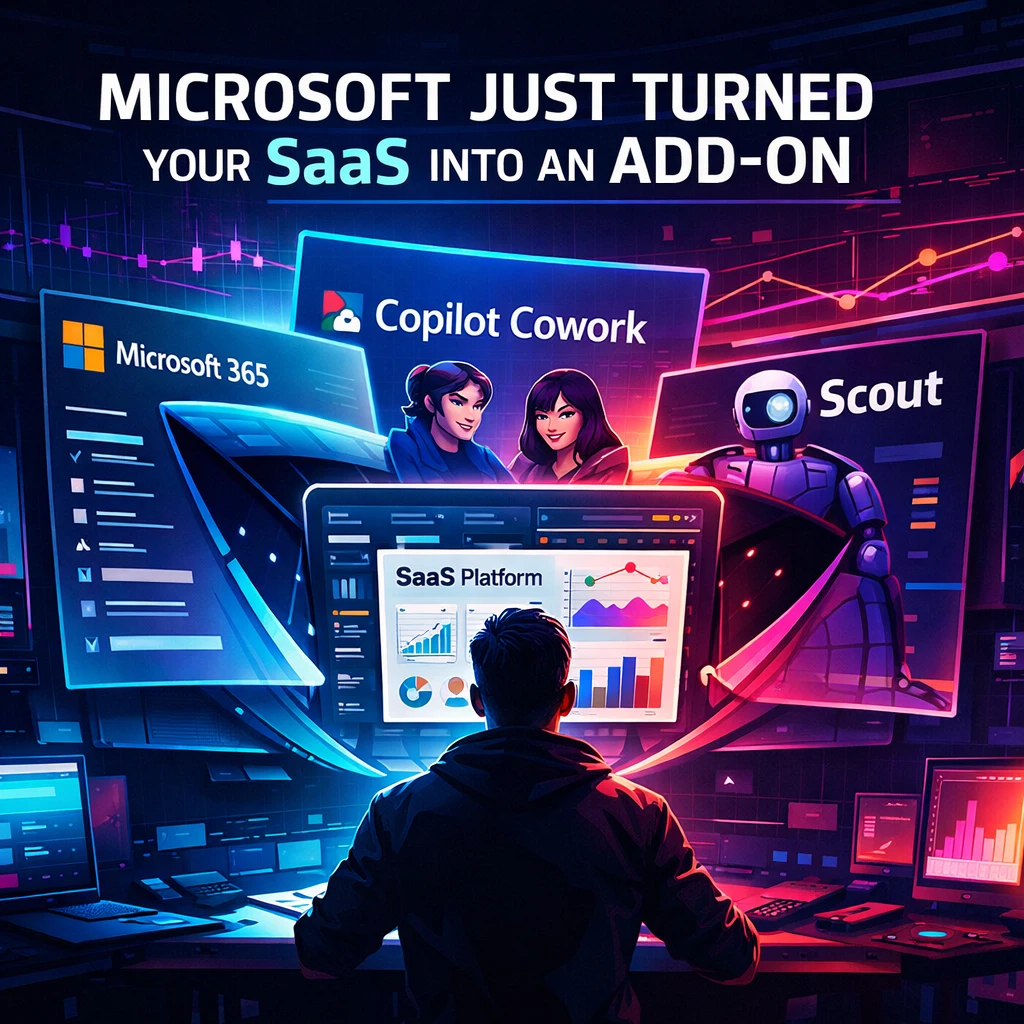

Microsoft has transformed Microsoft 365 into an integrated operating system for work, introducing features like Copilot Cowork and Microsoft Scout, which act as personal agents within the suite. This shift positions AI capabilities as inherent to Microsoft 365, complicating the landscape for AI startups that previously considered themselves primary solutions for workplace efficiency.
To compete effectively, AI founders must pivot away from generic workflows dominated by Microsoft and instead focus on niche, high-stakes tasks where their products can add unique value. By conducting a “Copilot overlap audit,” companies can identify areas where Microsoft’s tools may fall short and tailor their offerings to own specific workflows, thus establishing their products as indispensable in areas where Microsoft’s generic solutions cannot compete.
Microsoft didn’t “launch a feature” last week; it quietly turned Microsoft 365 into an agentic operating system for work and pushed a lot of AI SaaS into supporting-act territory.
On June 28, Microsoft announced general availability of Copilot Cowork and introduced Microsoft Scout, an always-on personal agent that spans cloud, desktop, and web, wired directly into Teams, Outlook, OneDrive, SharePoint, and everyday work data like chats, email, calendar, and contacts. Copilot Credits now sit underneath Work IQ API and Copilot Studio as a unified currency for building agents on top of that data, meaning the platform just standardized “agent UX + enterprise context” as a first-class product primitive.
Translated: for a huge chunk of your target customers, “AI agent that helps you work” is no longer your product category. It’s a native capability of the suite they already live in.
This matters because a lot of AI startups are still designing as if they’re the primary control surface for workflows Microsoft just claimed. If your value prop sounds suspiciously like “an AI agent that helps you write emails, prep meetings, or summarize docs,” you’re now fighting the default agent that’s literally baked into those emails, meetings, and docs.
Founders love to say “we’re building the AI teammate.” Microsoft just shipped the corporate version that already knows everyone’s calendars, permissions, and historical threads — and charges usage by Copilot Credits, not by your subscription tier. That’s not a feature race; that’s a battlefield change.
So what’s the non-delusional move here? Stop pretending you can out-Copilot Copilot on generic workflows, and start designing for the part of the stack Microsoft will never bother to own.
Microsoft Scout is optimised for broad, horizontal reach: coordinating tasks across Microsoft 365 and helping users complete multi-step work across common business scenarios. “Common” is the keyword. It will be great at generic collaboration and mediocre at niche, high-stakes, domain-specific sequences that actually decide whether your product lives or dies.
Your job as an AI founder is to ruthlessly identify the slice of work where Scout becomes noisy or blind — and make your product the calm, opinionated control surface for that slice. That shows up in design, not just positioning.
Concretely, it means:
- Your UX stops mirroring Microsoft’s flows and starts owning one end-to-end workflow your best users repeat multiple times a week.
- Your onboarding doesn’t “teach the product”; it teaches the specific decisions, risks, and data nuances your agent handles better than a generic corporate assistant.poplab+1
- Your product becomes the place where institutional memory for that workflow lives — audit trails, role-based access, domain-specific vocabulary — instead of yet another chat thread with some AI logo.
This is where Poplab tends to get pulled in: not to put lipstick on another “AI copilot,” but to redesign B2B dashboards, agentic UX, and onboarding so the product clearly owns a workflow instead of being swallowed by whatever Copilot or Scout ships next.
If you’re looking for a concrete move this week — not another think piece — run a “Copilot overlap audit” with your product and design leads.
Here’s the format:
- List your top three monetization-critical workflows — the ones that drive retention or revenue, not demo excitement.
- For each step in those workflows, ask brutally: “Could Microsoft Scout or Copilot Cowork do this at least 70% as well if the customer wired it up?”
- Wherever the honest answer is “yes,” stop designing for uniqueness there. Assume the platform will eat it. Your UI in those moments should integrate or get out of the way.
- Wherever the answer is “no” because domain nuance, regulation, or deep data models are required, that’s your product. Design those steps with an agentic UX that Scout can’t fake: explicit states, explainable decisions, visible trade-offs, and clear escalation paths when the agent isn’t sure.
Ship one redesigned workflow where your product is clearly the decision engine, not just another panel competing with Copilot’s sidebar. Then watch how your next investor conversation changes when you talk about “owning a workflow Microsoft can’t touch” instead of “being a better copilot.”
If you don’t do this, Copilot Cowork and Scout won’t just steal your buzzwords — they’ll quietly train your users that the real work happens somewhere else, and your beautifully designed app is just the plugin with nice colors.

Leave a Reply