
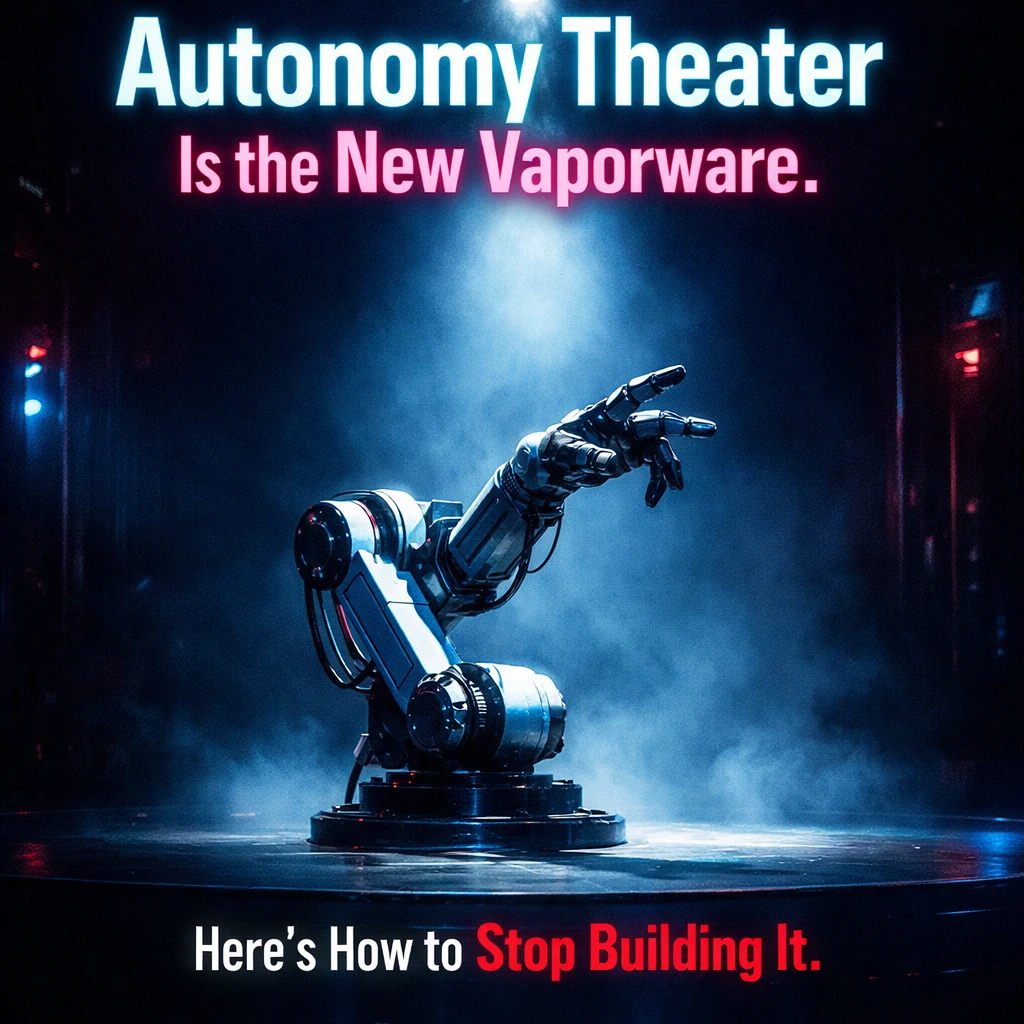


AI agent demonstrations often impress in controlled settings but fail in real-world applications, leading to the term “autonomy theater.” This phenomenon occurs when products appear autonomous but are unreliable in complex workflows, where ambiguous inputs and edge cases arise. Users prioritize reliability over the illusion of autonomy.
The current pressure to launch AI features has led to a focus on initial user impressions rather than long-term usability. Many products present confident outputs without addressing uncertainty, which can result in user frustration and increased churn. Effective design should make the agent’s reasoning visible and allow for user intervention before errors occur, ensuring a trustworthy experience.
Autonomy Theater Is the New Vaporware
The best AI agent demos of 2026 all follow the same script. Founder opens a screen recording. Agent receives a natural language prompt. Agent “thinks,” takes a series of confident autonomous actions, and delivers a crisp result. Founder smiles. Investors lean forward. Everyone agrees this changes everything.
Then a real user touches it.
The term has been making rounds in engineering circles for a reason: “autonomy theater.” It describes AI agent products that perform impressively in controlled conditions and degrade the moment they encounter the entropy of an actual business workflow — ambiguous inputs, missing context, edge cases the demo never acknowledged. The agent looks autonomous. It is not reliable. And reliability, not autonomy, is what users actually pay to keep.
Why This Is Happening Right Now
The pressure to ship agentic features has never been higher. Every platform — from OpenAI’s Workspace Agents to Microsoft’s Scout — is racing to normalize agent-based workflows as the new baseline of software. The market signal is real and the timing pressure is legitimate. What is not legitimate is shipping autonomy as a UI costume over a brittle chain of prompts with no fallback logic, no observable state, and no user trust mechanism built in.
The design failure here is specific. Founders are optimizing for the moment of first impression — the demo, the onboarding walkthrough, the hero animation on the landing page — and not for the third or fourth time a user runs the agent on a real task with real stakes. That gap is where churn lives. That gap is also where competitors quietly win.
The Design Diagnosis
Agentic UX fails not because the model is weak but because the interface treats uncertainty as shameful. Most AI agent products hide what the agent does not know. They present a confident output instead of a calibrated one. They give users no vocabulary for “the agent is unsure here” and no affordance to redirect before the agent commits an irreversible action.
This is a product design decision. It is not a model limitation. The agent can surface uncertainty. The designer chose not to show it — because it felt less impressive.
Real agentic UX does the opposite. It makes the agent’s reasoning legible at moments that matter. It gives users one clean intervention point before irreversible execution. It shows the shape of what the agent is doing without burying users in logs. Tight scope, visible state, graceful fallback: these are not compromises on the autonomy vision. They are what makes the autonomy vision survive a real workflow.
The Founder Move
Before you ship the next agent feature, run this test: put it in front of someone on your team who did not build it and did not see the demo. Give them a real task with at least one ambiguous input — a customer name with two matches, a date range that crosses a fiscal year, an instruction that could be interpreted two ways. Watch what the agent does. Watch what the user does when the agent does the wrong thing.
If the user cannot recover without engineering help, you have built autonomy theater. The fix is not a model upgrade. It is a UX layer that treats agent uncertainty as a first-class state and hands the user a clean interrupt — not a wall of JSON and not a silent wrong answer.
Scope the agent to one outcome. Instrument every run. Surface the agent’s confidence where it actually matters. That is the difference between a product that ships and one that gets quietly disabled after two weeks.
At Poplab, the Agentic UX & Copilot Blueprint is built exactly around this problem — mapping where automation earns trust and where it silently destroys it, before a single screen goes to engineering.
The market for trustworthy agent workflows is wide open. Most of your competitors are still rehearsing the demo.

Leave a Reply