
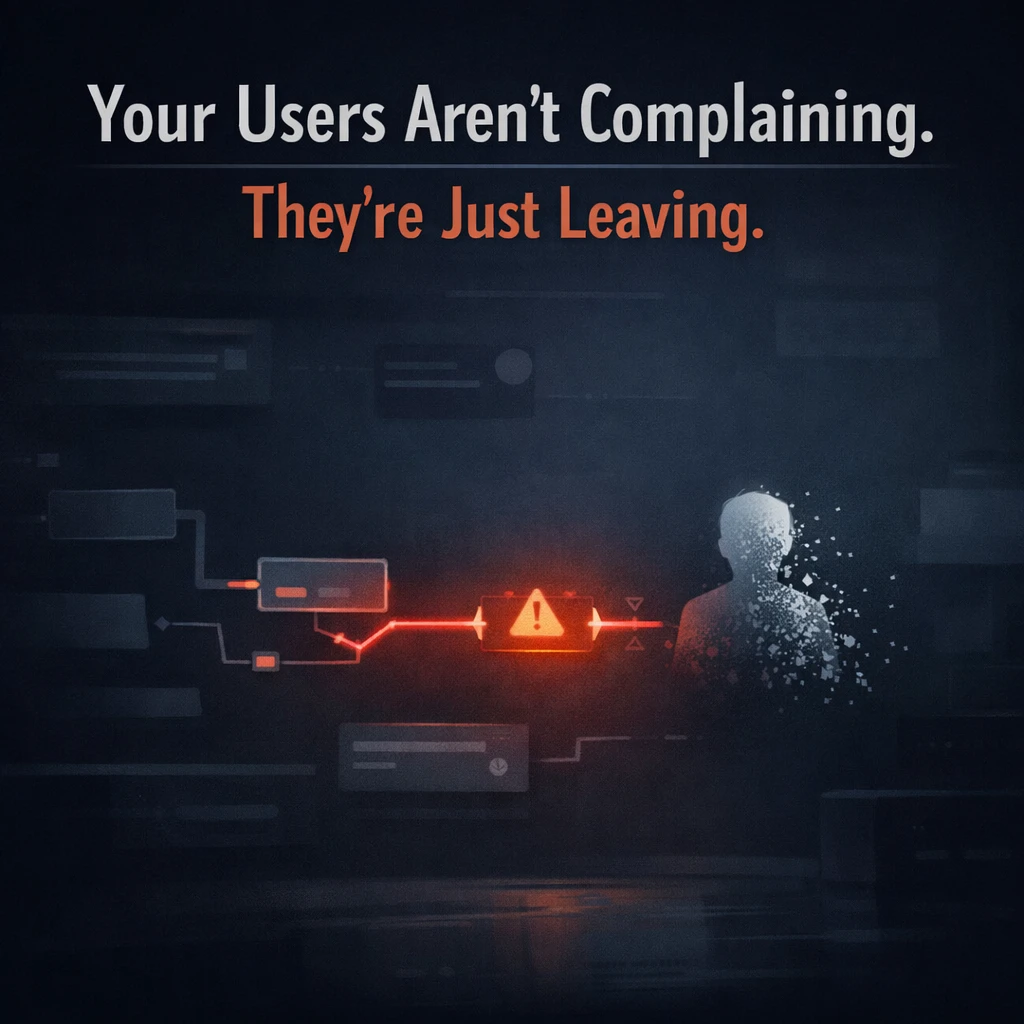


Silent churn, characterized by users who disengage without notifying support, poses a significant challenge for B2B SaaS companies, with 60% of users failing to recognize product value. This issue often stems from design flaws rather than marketing missteps, requiring proactive monitoring of user behavior.
The emergence of AI agents that perform well in demonstrations but falter in real-world scenarios compounds this problem, termed “autonomy theater.” To address silent churn, organizations should focus on observing user interactions to identify friction points rather than relying solely on dashboards. Tools like FlowAudit can automate the detection of issues, enhancing user retention.
The scariest churn isn’t the customer who emails support to cancel — it’s the one who never says a word. In 2026, median B2B SaaS activation still sits at 38%, meaning six in ten signups never even reach the moment your product proves its value. Nobody files a bug report for that. They just close the tab.
Silent Churn Is a Design Failure, Not a Marketing One
Silent churners give zero warning — no support ticket, no cancellation feedback, no angry review — they just quietly stop using the product until they’re gone. Teams that catch this early save 60-70% of at-risk customers, but only if they’re instrumented to see it coming instead of finding out from a revenue report 90 days later. The root cause almost never lives in your pricing or your feature set — it lives in the specific screen where a real user got confused, guessed wrong, and quietly gave up.
The New Culprit: AI Agents That Fail Silently
2026 added a nastier version of this problem: AI agents that act confidently and fail invisibly. Founders are now shipping agentic features that perform tasks well in demos but abandon users the moment something ambiguous happens — a duplicate name, a fiscal year edge case, an instruction with two readings. This has a name now: “autonomy theater” — a product that looks autonomous in a demo and falls apart in a real workflow with a real edge case. The fix isn’t a smarter model, it’s a UX layer that treats uncertainty as a first-class state instead of hiding it behind a spinner or a wall of JSON.
Where to Actually Look
Skip the dashboard for a minute and watch real sessions. Pick your single most important conversion event, then watch five session recordings of users who never reached it — don’t interpret, don’t rationalize, just note exactly where they slow down, misclick, or stop. This single exercise routinely surfaces friction clusters that months of A/B testing on ad copy never would, because you’re optimizing acquisition on a leak you haven’t found yet.
FlowAudit Finds the Leak Before It Becomes Churn
Manually reviewing session recordings and mapping every failure state across every flow doesn’t scale past your third audit. FlowAudit turns that manual, hours-long process into a 90-second automated pass that flags exactly where a flow breaks silently, ranked by severity.

Leave a Reply