
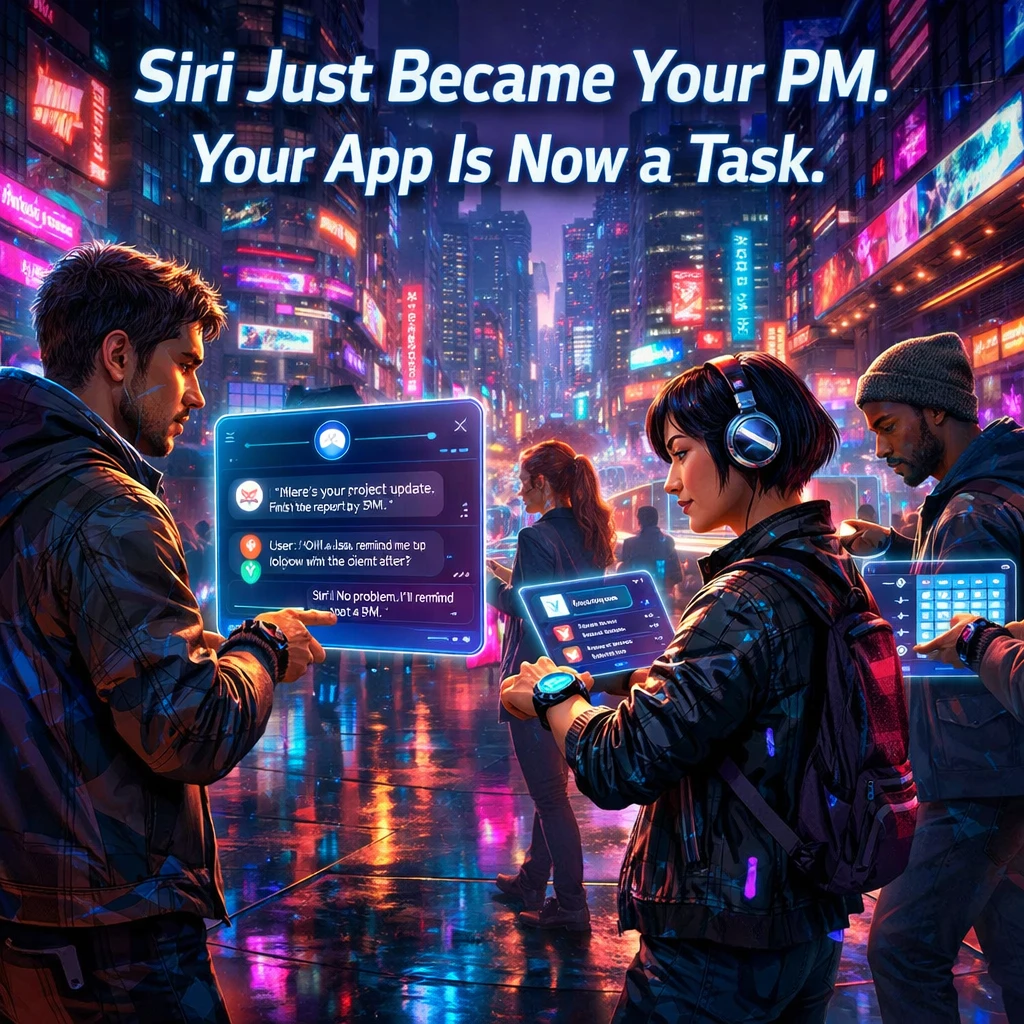


Designing AI products requires a shift from traditional app interfaces to focusing on user intents, especially with the anticipated changes in Siri’s functionality. The introduction of features like a chatbot UI and an Extensions framework in iOS 27 will position Siri as an OS-level router, influencing how users interact with applications.
To adapt, product developers must prioritize clear APIs, predictable outcomes, and seamless onboarding processes. A “Siri-first” approach involves defining user requests, mapping them to specific capabilities, and ensuring the product is designed to be easily invoked by Siri, ultimately transforming the user’s experience with AI products.
If you’re still designing your AI product around “the app” or “the dashboard,” you’re already behind. Siri is about to sit between your users and your UI — and it’s going to judge your product by how well it behaves as a background task, not a destination.
In the last days, Apple quietly spun up genai.apple.com ahead of WWDC 2026, with leaks pointing to “Siri 2.0”: a chatbot-style redesign with Dynamic Island integration, a dedicated Siri app, conversation history, and multi-step task handling across apps. Underneath the cosmetic changes is the real shift: an Extensions framework in iOS 27 that lets users route Siri requests to third‑party AI services like Claude and Gemini, effectively turning Siri into an OS-level router of intent. That router is backed by a reported one‑billion‑dollar‑per‑year Gemini deal, with Apple keeping compute under its Private Cloud Compute model so everything still feels “Apple‑safe.”
Translation: your user will increasingly say “Siri, handle this” — and the OS will decide whether your product is worth involving.
This isn’t just another “AI assistant” headline to scroll past. When Siri gets a full chatbot UI, persistent memory, and the ability to orchestrate multi-step flows across apps, it stops being a voice shortcut and becomes the default entry point for complex tasks on Apple devices. Add Extensions, and your product is no longer the first screen; it’s a capability that gets called when the system deems you the right tool for the job.
For AI startup founders, that blows up a lot of lazy assumptions:
- You can’t rely on “open the app and we’ll educate them with onboarding” anymore.
- You can’t assume users will ever see your carefully layered navigation.
- You definitely can’t assume the “user” is always a human; sometimes it’s Siri orchestrating on their behalf.
The winners here will be products that are legible to an OS‑level agent: clear jobs‑to‑be‑done, clean APIs, predictable side effects, and outcomes that are easy to summarize back to the user.
So what do you actually change?
First, you redesign around intents, not pages. Make a list of the top 10 sentences a user might say to Siri that should involve your product: “track this invoice,” “summarize this customer thread,” “draft a reply using our knowledge base,” “spin up a sandbox environment for this customer,” and so on. Each of those needs a single, idempotent, well-defined capability behind it — not a seven-step UI flow masquerading as “flexibility.”
Second, you tighten your product’s contract with the outside world. That means:
- APIs that map 1:1 to real user outcomes, not your internal data model.
- Clear error states and safe defaults so an agent can fail gracefully without wrecking someone’s account.
- Outputs that are structured enough for Siri to explain back in one or two sentences without hallucinating what you actually did.
Third, you rethink onboarding as “first successful intent,” not “first session.” Your activation moment isn’t when a user finishes a tour; it’s when Siri completes a task through your product and the user thinks, “That was painless, do it again.” Everything in your UX — pricing, permissions, settings, guardrails — should make that first delegated task safe, fast, and repeatable.
At Poplab, this is exactly the layer we design in our Agentic UX & Copilot Blueprint work: the decision model, guardrails, and interaction patterns that let agents act on your product without turning it into a compliance nightmare or UX roulette table. The same thinking applies here — except now the “agent” is baked into the operating system, not just your own app.
If you do one thing this week, run a two‑day “Siri‑first” sprint with your team:
- Day 1 morning: Write down 10 natural‑language requests your ideal user would speak to their phone that should trigger your product.
- Day 1 afternoon: For each, define the exact input your system needs, the side effects it creates, and the response a user should hear back.
- Day 2: Sketch the minimum API, permissions, and UX changes required to make those 3–5 highest‑value intents safe and shippable — even if Siri integration isn’t available yet.
You’re not doing this to chase an Apple announcement. You’re doing it because the OS is becoming the real interface, and your product is either a sharp, callable capability — or invisible infrastructure waiting to be replaced.
Siri 2.0 is not a feature drop; it’s your UX design review, scheduled by Apple.

Leave a Reply