
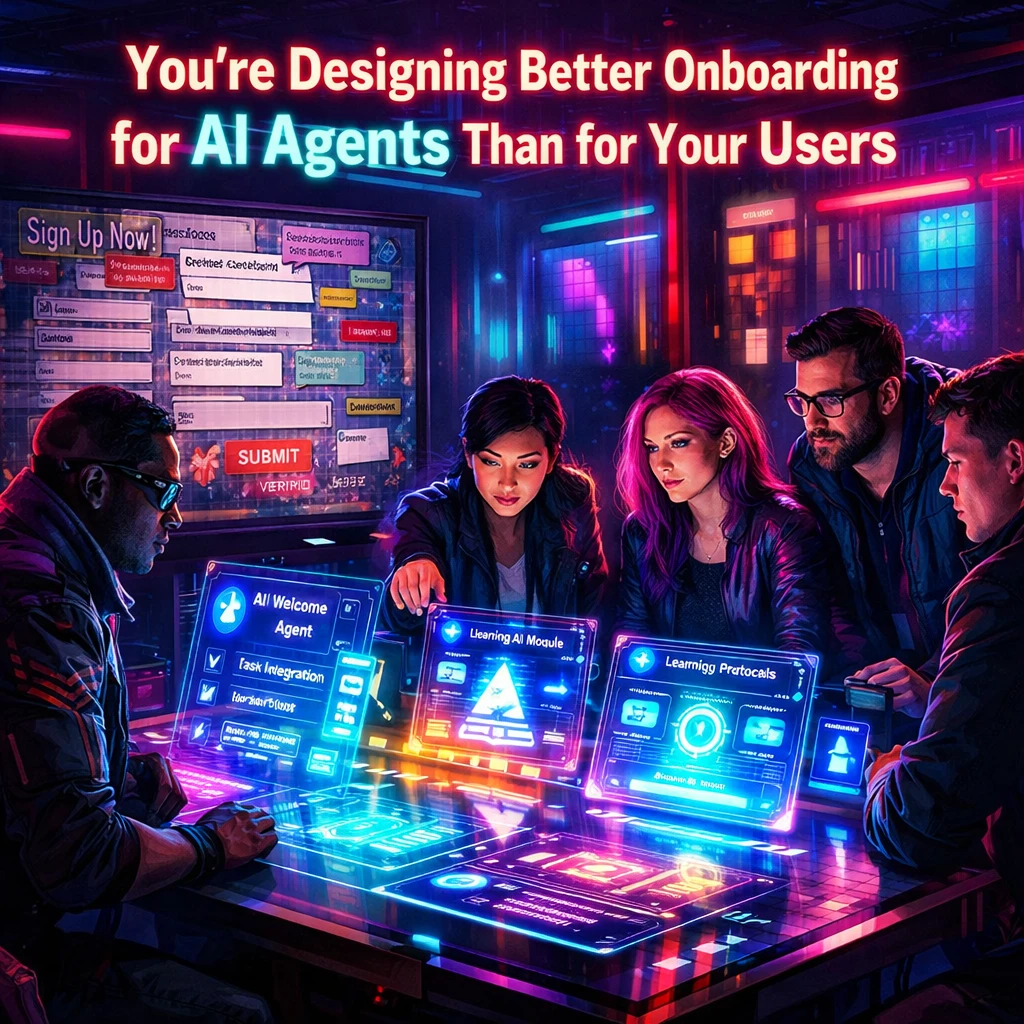


Recent developments in AI agent platforms highlight a disparity in user onboarding experiences. While platforms like agnt8x and Oscilar provide comprehensive onboarding for AI agents, human users often face generic and ineffective signup processes. This inconsistency underscores a critical oversight in prioritizing infrastructure over user experience.
Founders should recognize that improving activation and user experience is essential for growth. The article suggests applying the rigorous onboarding strategies used for AI agents to human users, emphasizing the need for clear objectives, monitored metrics, and effective UI design. By addressing these gaps, companies can enhance user engagement and drive revenue.
Every week another “AI agent platform” launches, and the pattern is getting funny. The agents are getting beautiful onboarding. Your human users aren’t.
Earlier this month, agnt8x came out of stealth with what is basically a recruitment and workforce management platform for AI agents—find, hire, onboard, manage, orchestrate, all behind a unified passport and audit trail. They even talk about a nine-step onboarding flow for agents, complete with policies, roles, and monitoring. In parallel, risk-platforms like Oscilar are rolling out suites of 30+ AI agents coordinated across fraud, onboarding, and compliance, again with rich dashboards and governance built in.
We are designing carefully staged flows to make sure non-human workers can be trusted before they touch anything important… while most SaaS products still greet human users with a generic signup form, a random tour, and a “hope you figure it out” dashboard.
This isn’t just ironic. It exposes where founders are over-investing: infrastructure over experience.
Agentic stacks are getting first-class treatment. Clear roles, tight guardrails, observable behavior, explicit success metrics. That’s exactly how good user onboarding is supposed to work—and exactly what’s missing in most actual user flows. When I look at typical SaaS onboarding in 2026, it’s still “name, email, company size, here’s a cluttered UI, good luck.” Meanwhile, the agent that nudges that user in-product is living its best life inside a rigorously designed control plane.
Zoom out and this tracks with broader UX trends. 2026 SaaS UX is increasingly modular, adaptive, and data-driven—especially on the back-end. Teams obsess over composable architectures and AI-native layouts, yet the first 15 minutes of the product still feel like 2018. It’s easier to add another agent than to rewrite the signup flow, so guess which one happens.
Why does this matter to founders? Because activation is still the growth bottleneck, not model quality. Benchmarks across PLG and B2B SaaS have been screaming the same thing all year: activation and time-to-value drive revenue far more than another incremental capability. If your first-run experience is confusing, no amount of agent orchestration will save you.
The agentic launches are a giant, blinking reminder of what “grown up” onboarding looks like:
- A clear, narrow job to be done.
- A staged path into risk and responsibility.
- Continuous monitoring with real metrics, not vibes.
That’s exactly how your user flows should be designed.
The concrete takeaway: steal your agent workforce playbook and apply it to human onboarding this week. Take one critical flow—signup → first meaningful outcome—and write it up the way you’d spec an AI agent:
- What single outcome is this flow accountable for in the first session?
- What is the smallest real task that proves the product can deliver that outcome?
- What’s the worst failure mode for the user, and how does the UI prevent or recover from it?
Then instrument that path as aggressively as you instrument your agents: completion rates, time-to-first-outcome, drop-off points. If you can’t see those numbers today, that’s the real infrastructure gap.
At Poplab, I keep seeing the same pattern with AI founders: the infra roadmap is pristine, but the critical flows—pricing, onboarding, checkout—haven’t had a serious UX review in years. That’s why I built FlowAudit to run fast, AI-powered heuristic reviews on a single underperforming flow and spit out a prioritized fix list you can actually ship, not a vague “UX score” that nobody owns.
Agent platforms treating onboarding as a first-class citizen is the direction of travel. Just don’t make the mistake of giving better experiences to your AI workers than to the humans who pay you.

Leave a Reply