The Short Version
Aeonvis is an Italian enterprise consulting firm with 200+ consultants, 150+ enterprise clients, and 400+ projects delivered across 50 countries — advising organizations on digital transformation, SAP and Salesforce implementation, and advanced analytics. Despite that scale, the website had received no strategic investment for years: it generated no qualified pipeline, had no CRM integration, and communicated nothing about the company’s expanded capabilities following a recent acquisition. The firm was effectively absent from organic search in a market where enterprise procurement decisions start online, while talent acquisition relied entirely on third-party platforms it didn’t own.
I owned the project end-to-end as lead experience designer and project lead — UX, visual design, brand strategy, AI-assisted content production, and full project management across Poplab, a development partner, and multiple client stakeholder streams over a 12-week engagement.
I reframed the brief from a cosmetic refresh into a growth infrastructure project, defining conversion goals and Salesforce pipeline tracking before touching a wireframe. I developed a full brand storytelling framework and tone of voice guide with Aeonvis leadership, and anchored every creative decision to a competitive benchmark to navigate strong stakeholder opinions on visual direction without losing coherence. I embedded Claude, ChatGPT, Figma Make, and Freepik’s generative AI models throughout production to deliver quality within a fixed timeline.
Six months post-launch, organic traffic grew 41%, qualified leads increased 32% through the new Salesforce integration, the conversion rate rose 36%, and job applications jumped 61% — turning a passive credential into an active commercial and talent channel.
Role: Lead Experience Designer & Project Lead, Poplab
Company: Aeonvis S.p.A. — an Italian organizational and technology consulting firm specializing in digital transformation, management consulting, business integration, and advanced analytics | 200+ consultants, 4 offices across Italy, 150+ enterprise clients, 400+ projects delivered across 50+ countries, ISO 9001 certified
Scope:
- Full website strategy, information architecture, UX, and visual design for aeonvis.com — all pages, flows, and component states
- Brand strategy, tone of voice definition, and storytelling concept development — from positioning workshop to a full brand communication guidebook
- Competitive benchmarking across direct and indirect consulting competitors — informing both creative direction and content strategy
- Acquired brand (Artmatica Partners) integration: content migration, SEO continuity strategy, and unified narrative architecture
- Salesforce CRM integration design: lead capture forms, routing logic, and pipeline tracking
- Talent acquisition product design: careers section, candidate journey, and direct application flow
- AI-generated visual asset production: all imagery and the majority of site content produced with generative AI
- Brand asset system: institutional deck, icon set, PowerPoint templates, and brand guidelines
- End-to-end project management: steering a cross-functional team across Poplab, Y-Tech (development partner), and multiple client stakeholder streams — over a 12-week engagement
Background
Aeonvis is an Italian IT consulting firm with 20+ years of delivery history, operating across five practice areas: management consulting, project management and governance, business integration, digital and advanced analytics, and application maintenance services. When I took on this project, the company was 200 consultants strong with offices in Milan, Turin, Padua, and Rome, and had delivered 400+ projects for enterprise clients across sectors including automotive, FMCG, fashion, pharma, and manufacturing — with a delivery footprint spanning 50+ countries. The firm had also recently completed a strategic acquisition that meaningfully expanded its service capability and consultant base, creating both a narrative opportunity and a content integration challenge.

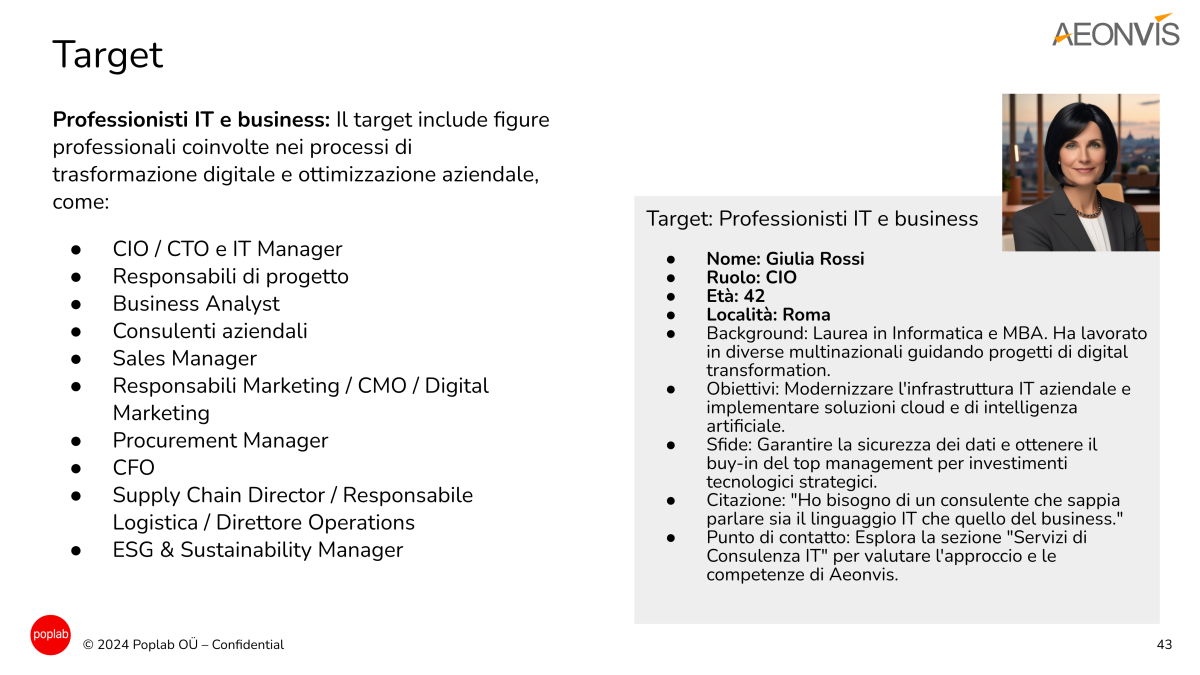
The two primary audiences of the Aeonvis website were high-value enterprise decision-makers — typically Chief Digital Officers, IT Directors, and supply chain heads evaluating consulting partners for multi-year transformation programs — and experienced consulting talent, including SAP specialists, project managers, and digital analysts assessing Aeonvis as a career move against both Big 4 firms and boutique competitors. Both audiences arrive with high expectations and limited patience. For enterprise buyers, credibility has to read immediately; for talent, culture and opportunity have to feel authentic within seconds.
I held full responsibility end-to-end: project strategy, UX architecture, visual design direction, brand and communication strategy, AI-assisted content production, and complete project management across both the Poplab team and the development partner. Y-Tech managed WordPress front-end and back-end development and SEO implementation as an extended team under my direction. On the client side, I coordinated directly with a broad stakeholder ecosystem: the Head of Digital Transformation, the Marketing Director, the CTO, the HR and Talent Acquisition Lead, and multiple unit heads and vertical specialists across Aeonvis’s practice areas.
The Problem
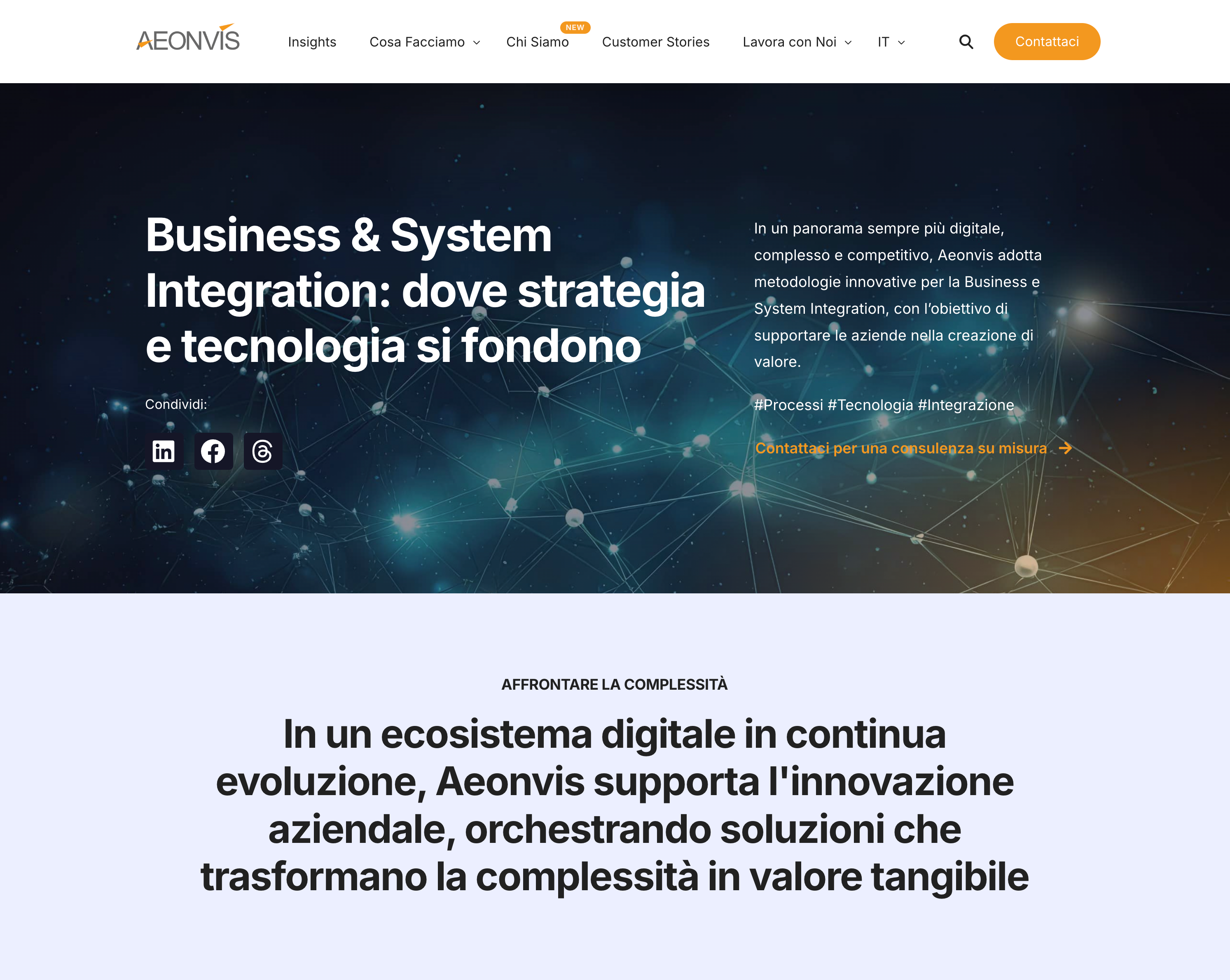
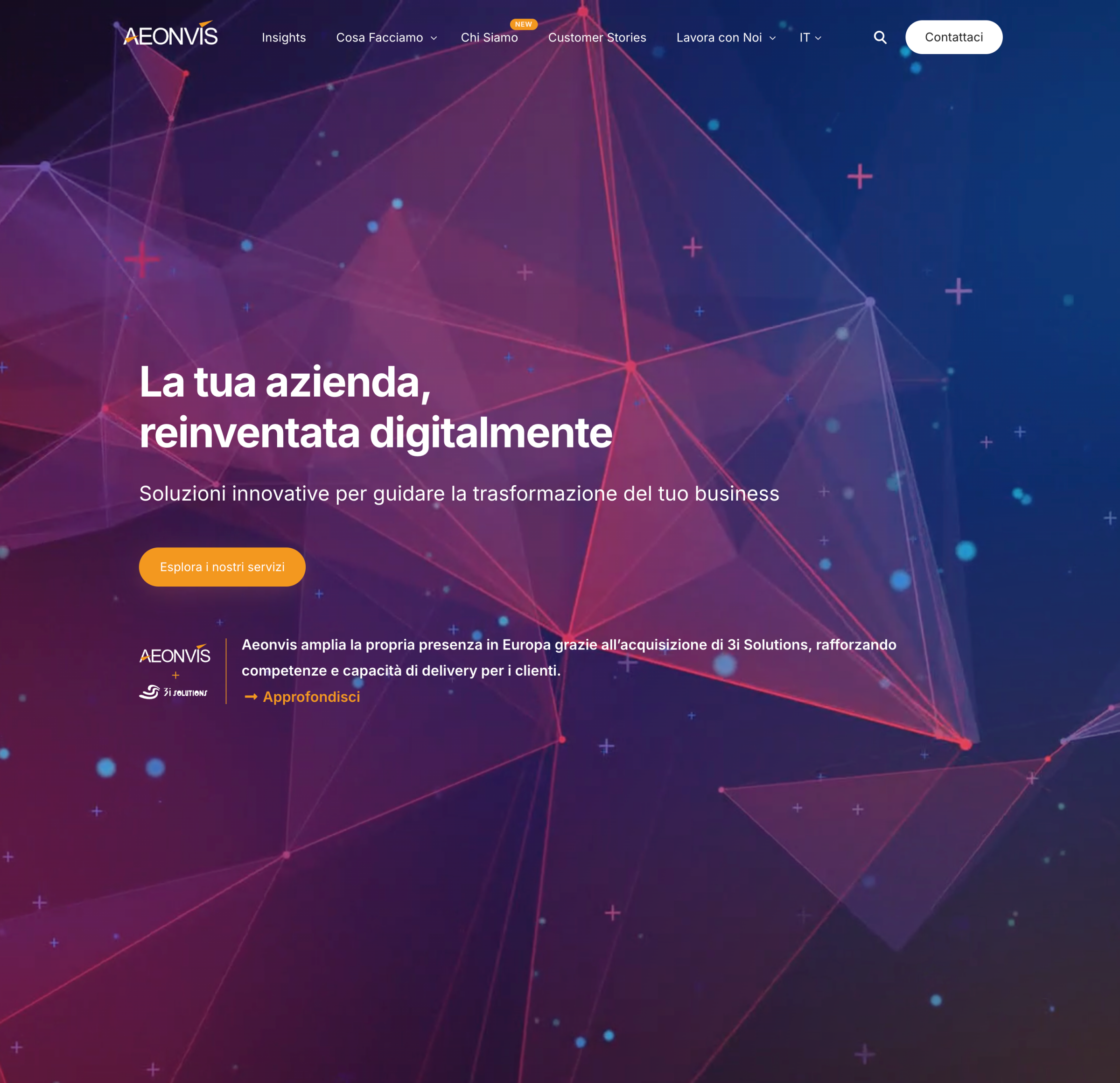
Aeonvis had grown substantially — new services, a completed acquisition, an expanded 50-country delivery footprint — and their digital presence hadn’t kept pace. The company’s most commercially valuable asset, its depth of enterprise delivery experience across Salesforce, SAP, Kinaxis, and advanced analytics, existed almost exclusively in PowerPoint decks and direct sales conversations. Enterprise buyers searching for consulting partners in these areas had no reliable way to discover Aeonvis organically. Without an active SEO strategy or content architecture, the company was effectively absent from the digital channels where enterprise procurement decisions start. The initial site audit estimated monthly organic traffic in the range of 2,000–2,500 sessions, with a bounce rate above 68% and a contact form conversion rate well below 1% — consistent with an institutional site that had received no strategic digital investment since its original build.
Lead management had not yet been centralized or tracked through the CRM. Leads that did arrive via the site were handled manually, with no Salesforce routing, no pipeline visibility, and no connection between digital activity and commercial outcomes. The Artmatica acquisition had added real capability to the Aeonvis story — new services, new consultants, new client relationships — but the existing site had no mechanism to communicate this expanded identity. Potential clients evaluating the firm were working with an incomplete picture.
“Poplab’s AI-powered prototyping and UX/UI Design transformed our digital presence—organic traffic surged 41% and conversions jumped 36%. This proves how deploying advanced AI tools with design thinking delivers business growth, not just pretty visuals.”
— Head of Digital Transformation, Aeonvis
Talent acquisition faced a parallel gap. Aeonvis was competing for experienced IT consultants in a tight market, relying primarily on third-party platforms like LinkedIn and Indeed to source candidates. Their careers section didn’t yet communicate company culture, team life, or career trajectory — and offered no direct application path. The company was spending to acquire candidate attention on platforms it didn’t own, while an untapped owned channel sat idle. The strategic opportunity across all three fronts was the same: transform the website from a passive credential into an active business function — one that generates leads, builds talent pipeline, and communicates a company that operates at the level it actually does.
Strategic Decisions
1. Reframe the brief from “website refresh” to “digital growth infrastructure”
The original request was to modernize an outdated website. I rejected that framing in the first client workshop. A cosmetically updated brochure produces better-looking, equally passive results — it doesn’t change pipeline, talent acquisition, or competitive positioning. Before touching a single wireframe, I ran a structured discovery workshop with key Aeonvis stakeholders to redefine the project goal: every page needed a defined conversion objective, every section needed to map to a specific user intent, and every CTA needed to feed a trackable Salesforce outcome. This framing shift shaped every downstream decision — content hierarchy, navigation architecture, section sequencing, and how we defined project success. The alternative was a redesign that would win internal approval and underdeliver commercially. I rejected it as a misuse of the client’s budget and our engagement.
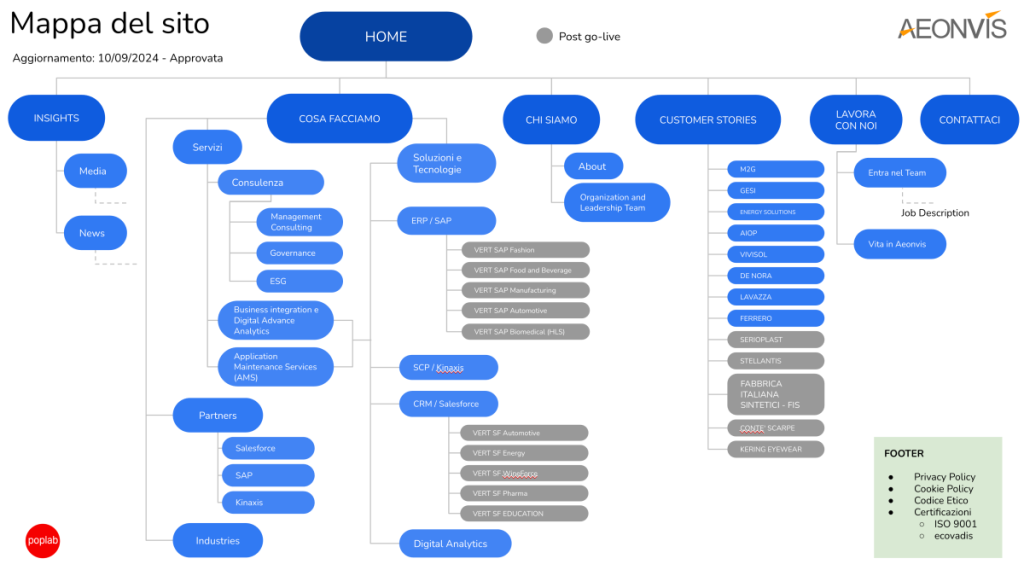
2. Build the brand voice and storytelling strategy before designing anything
One of the first things I identified was that Aeonvis didn’t have a clear, documented positioning or communication framework — different stakeholders described the company differently, and the existing site language was generic and self-referential. Rather than retrofitting messaging around the design, I pushed for a dedicated brand and storytelling phase before UX work began. Working collaboratively with the Head of Digital Transformation and the Marketing Director, we developed a full storytelling concept — “Integrated Business Evolution Orchestrators” — along with a comprehensive tone of voice guide: eight communication principles, a keyword bank, and explicit do/don’t guidelines for all web copy. This became the creative and editorial north star for the entire project. Every headline, service description, and case study narrative was written against it. The trade-off was timeline — this extended the discovery phase — but it eliminated ambiguity downstream and gave us a defensible reference point when stakeholder opinions on copy diverged.
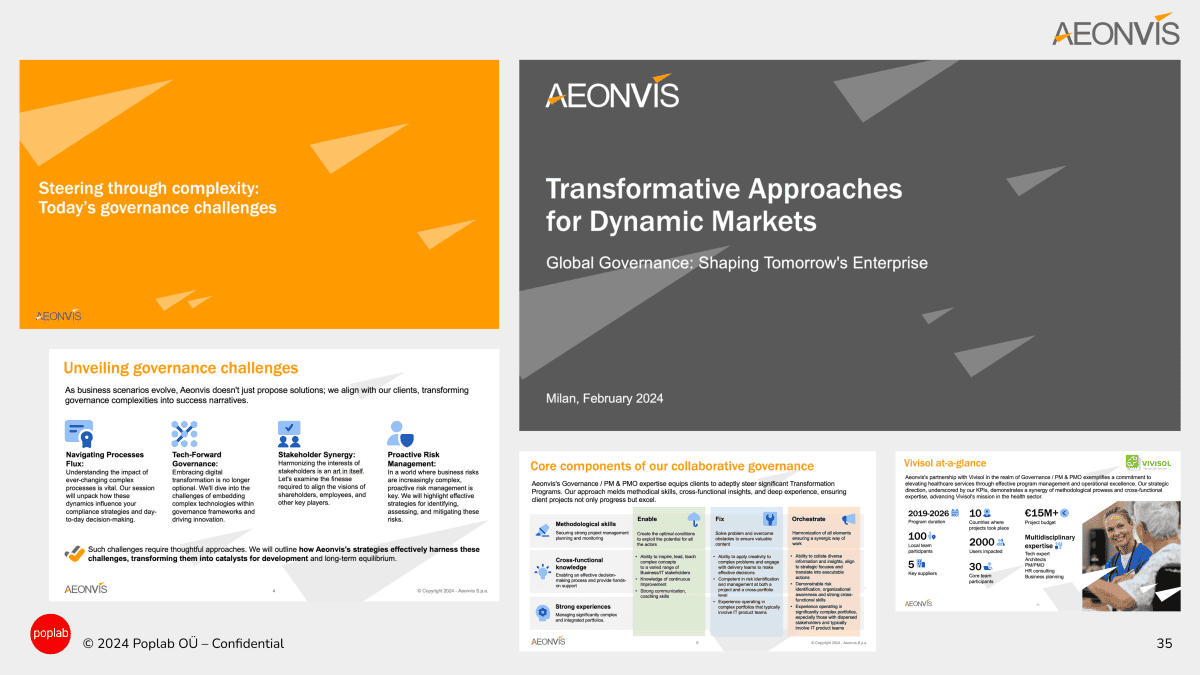
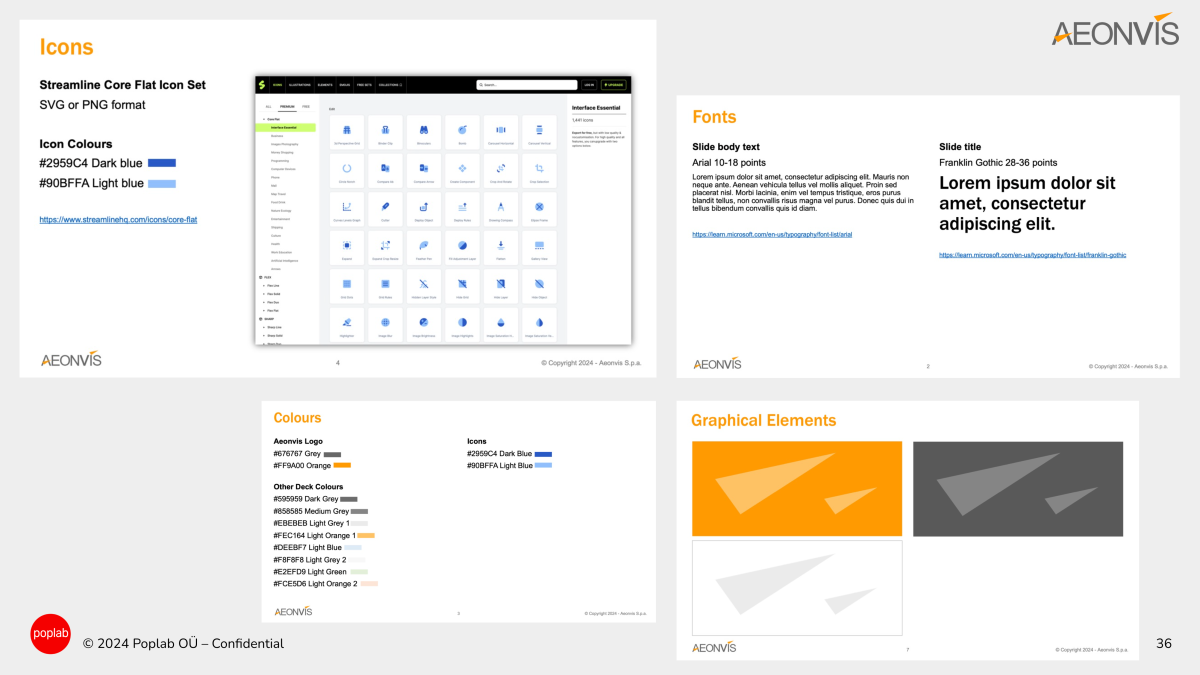
3. Use deep competitive benchmarking to anchor creative decisions in market reality
Creative direction without competitive context is just taste. Before any visual concepts were developed, I conducted a thorough benchmark analysis of Aeonvis’s direct and indirect competitors — examining design language, content hierarchy, messaging strategy, and user experience patterns across the consulting sector. This benchmark served two functions: it identified genuine differentiation opportunities for Aeonvis, and it gave us an objective reference point during stakeholder reviews when subjective preferences surfaced. When key stakeholders had strong personal opinions about visual direction — which they did, and which created real friction at design review stages — the benchmark allowed me to redirect conversations from “I like / I don’t like” to “here’s what the competitive landscape looks like and here’s the differentiated position we agreed to hold.” That reframe resolved most disagreements without creative compromise.
4. Embed AI into the production workflow as a structural velocity tool
This project ran on a fixed budget with a 12-week timeline while requiring an unusually high volume of content production: service descriptions, case studies, team bios, careers narratives, English translations, and a complete visual asset library. I embedded AI tools structurally into every production layer from week one. I used Claude and ChatGPT for first-draft content generation, structural messaging, and translation work — the Aeonvis team reviewed and refined rather than originated from scratch, compressing the content review cycle substantially. I used Figma and Figma Make for UI design, rapid creative variant generation, and component spec delivery. All site imagery was produced using generative AI tools — primarily Freepik’s AI suite with multiple generative models — eliminating the cost and timeline of a traditional stock or photography workflow. Trello managed the full project backlog: sprint planning, milestone tracking, stakeholder review cycles, and cross-team dependencies across Poplab and Y-Tech. The result was a compressed discovery-to-launch pipeline that hit quality and deadline targets simultaneously.
5. Choose a customized WordPress theme foundation over a custom build
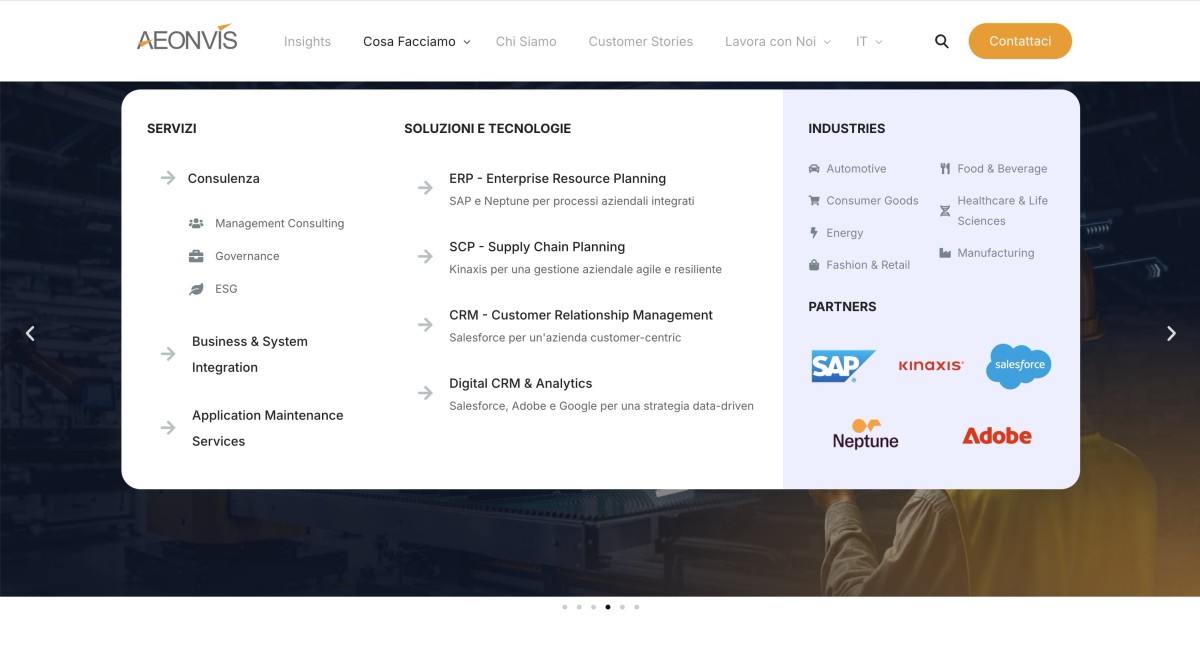
I evaluated headless CMS architectures and fully custom development and rejected both for this context. A headless build would have consumed a disproportionate share of the budget on infrastructure rather than experience quality, and would have left the Aeonvis content team dependent on engineering support for routine publishing. A custom WordPress build from scratch would have extended the development timeline beyond the agreed scope. I chose a performance-optimized WordPress theme as the structural foundation, then specified full customization through detailed Figma component specs — annotated with states, breakpoints, typographic scales, and interaction behaviors — that Y-Tech used as a precise build reference. The theme was the scaffold; the design system was the specification. This approach meant the site launched looking like the Figma file, not like a compromised version of it.
“Using Poplab’s AI-augmented Content Creation and SEO strategies, we generated 32% more qualified leads and a 28% increase in demo requests. Their multidisciplinary approach aligned every web touchpoint with measurable outcomes and strategic vision.”
— Marketing Director, Aeonvis
6. Design the careers section as a standalone product experience
I pushed to treat the “Work with Aeonvis” section as a product in its own right rather than a page bolted onto the navigation. This meant a structured narrative arc: company culture, authentic team and office life content, career paths by practice area, employee stories, and a direct application flow integrated with LinkedIn and Indeed rather than duplicating them. The business rationale was straightforward: Aeonvis was spending budget acquiring talent attention on third-party platforms while operating a zero-converting owned channel. Changing that was a design investment with measurable commercial return. The trade-off was scope and content production effort — this section required the most original content in the project and stretched the production timeline. The 61% increase in job applications post-launch made the argument clearly.
Process & Approach
Phase 1 — Discovery: Build the foundation before touching a pixel
I opened the project with a structured discovery sprint before any design work began. This meant running in-depth workshops with key Aeonvis stakeholders to surface objectives, align on user personas, define scope, and establish measurable success criteria for every section of the site. Simultaneously, I commissioned a full audit of the existing digital infrastructure — content inventory, SEO baseline assessment, Bluehost hosting environment review — and ran a thorough competitive benchmark analysis examining how leading consulting firms positioned themselves across design language, content hierarchy, messaging strategy, and user experience patterns. I also worked directly with the client’s leadership team to extract and codify their brand identity, core values, mission, and vision — the raw material that would later become the formal tone of voice and storytelling framework. This phase was deliberately unhurried. The time invested here compressed every subsequent phase, because decisions were grounded rather than assumed.
Phase 2 — Ideation & Design: Co-create with the client, not for them
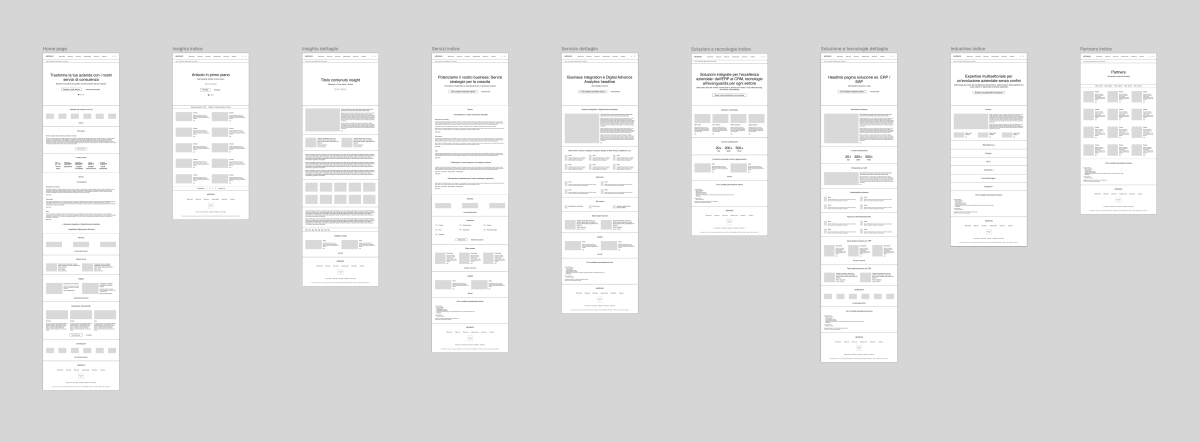
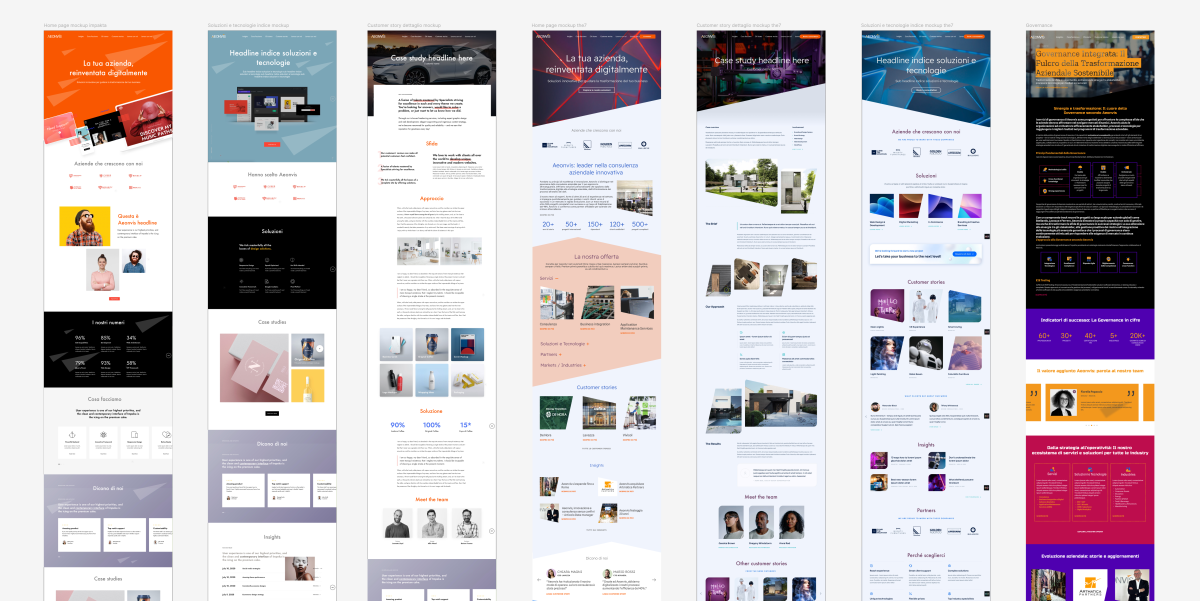
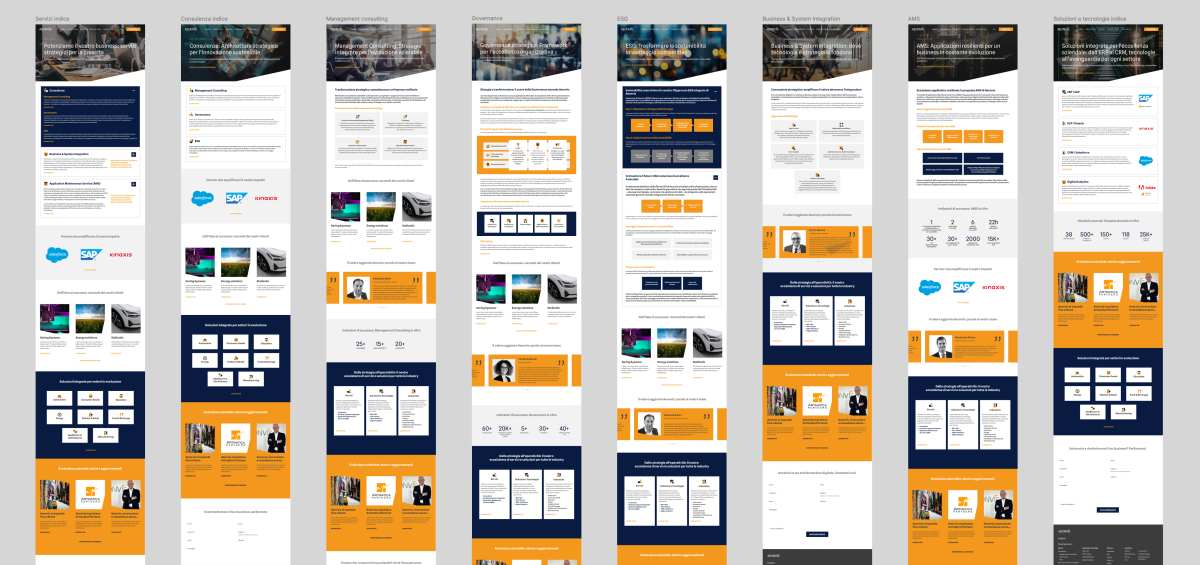
With the discovery foundation in place, I moved into UX architecture and visual design — all executed in Figma. I designed detailed wireframes across all key page templates, mapping navigation logic, information hierarchy, and user flows for three distinct personas: enterprise buyer, talent candidate, and existing client. These wireframes were reviewed and refined with Aeonvis stakeholders in an agile feedback cycle, keeping the product owner and key stakeholders as co-authors of the experience rather than passive reviewers. In parallel, I selected and specified the WordPress theme base — the structural scaffold that Y-Tech would later customize against my design system — and began the visual design phase: evolving the brand into a full UI system, producing the icon set, and directing the AI-generated visual asset library. I used Claude and ChatGPT to generate structured content drafts anchored to the brand voice framework, Figma and Figma Make for design variants and component specs, and Freepik’s generative AI models for all site imagery. Every creative decision in this phase was traceable back to either the competitive benchmark or the agreed brand communication framework — which became critical during stakeholder reviews where personal preferences surfaced strongly around visual direction. The benchmark gave us a shared objective reference to navigate those moments without losing creative coherence.
Phase 3 — Implementation, Testing & Launch: Precision handoff, zero fidelity loss
I handed Y-Tech a fully annotated Figma component library — not a mood board, not a static mockup, but a living design system with states, breakpoints, interaction behaviors, and typographic scales specified per component. This precision was deliberate: fidelity loss in the browser is almost always a handoff problem, not a development problem. I maintained the Figma file as a live reference throughout the build, joining weekly implementation syncs to address questions early. Content production ran in parallel — service descriptions, case studies, team narratives, careers content, and English translations, the majority AI-assisted with human editorial review. The Salesforce integration was spec’d at the form, routing, and confirmation-state level before Y-Tech touched a line of code. SEO strategy — including the Artmatica migration redirects — was implemented by the SEO engineer against a content architecture I designed. After staging deployment on Bluehost, we ran rigorous cross-device and cross-browser testing, performance optimization via Google PageSpeed Insights, analytics configuration, and backup setup before going live. Post-launch, I maintained a monitoring and bug-fix cycle and gathered early visitor feedback to inform the first round of live optimizations.
Collaboration
With Product (Client Leadership & Product Owner):
I maintained a close, continuous working relationship with the primary product owner — the Head of Digital Transformation — throughout the engagement. Rather than presenting finished designs for approval, I structured the project so that key decisions were co-authored: the site map, conversion goals by section, content priorities, and the brand communication framework were all built jointly in workshops rather than handed over as outputs. This co-ownership approach meant stakeholders had genuine investment in the direction before it was built, which significantly reduced late-stage revision risk. Beyond the product owner, I managed a broad stakeholder ecosystem that included the CFO, CTO, Marketing Director, HR and Talent Acquisition Lead, and multiple unit heads and vertical specialists — each with distinct priorities and success criteria. Weekly all-hands syncs, structured around Trello’s project board, kept every stakeholder stream aligned without losing momentum.
With Engineering (Y-Tech):
Y-Tech served as my extended technical team for the full duration of the project — front-end and back-end development, WordPress configuration, plugin management, Salesforce integration, and SEO implementation. I treated the handoff as a design-to-engineering contract: fully annotated Figma specs with component states, grid definitions, responsive breakpoints, and interaction notes, maintained as a live reference throughout the build rather than a one-time delivery. We held dedicated weekly implementation syncs to surface technical constraints early and prevent fidelity loss during development. The Salesforce integration — the most technically complex deliverable — was specified at the form, field, routing, and confirmation-state level before Y-Tech began development, which kept that workstream on schedule. The site that launched matched the design system precisely because expectations were explicit from day one.
With Leadership / Stakeholders:
The most complex stakeholder dynamic was around creative direction. Aeonvis had strong internal opinions about visual identity — which is natural and healthy, but required active management to prevent the design process from fragmenting into a committee. I addressed this by establishing two anchors early: the competitive benchmark (which showed what the market looked like and where Aeonvis could differentiate) and the brand and tone of voice framework (which gave every creative decision a written standard to be measured against). When personal preferences surfaced during design reviews — and they did, repeatedly — I could redirect to these shared references rather than defending subjective choices. This kept creative reviews productive and protected the coherence of the final output. With the broader executive stakeholder group, I consistently translated design decisions into business language: conversion goals, talent pipeline impact, pipeline visibility through Salesforce — not aesthetic rationale.
“AI-enabled user journey mapping—including career pages and Salesforce integration—drove 61% more job applications and a 34% rise in contact form completions. Poplab’s exacting UX process and agile partnership turned our site into a true talent and client magnet.”
— HR & Talent Acquisition Lead, Aeonvis
With the Design Team:
This was not a conventional multi-designer studio engagement. I operated simultaneously as lead designer, creative director, content strategist, and project manager — spanning UX architecture, visual design, AI-assisted production, brand development, and full cross-team coordination across Poplab and Y-Tech. The complexity of managing a service-provider/client ecosystem — with stakeholders at multiple organizational levels on the client side and a full delivery team on ours — required constant context-switching and disciplined prioritization. What I’m most proud of is that despite this complexity, the quality of the design output didn’t suffer from the operational load. Every component was documented, every spec was precise, and the work that shipped was held to the same standard as if I’d had a dedicated design team around me. The project also produced a reusable foundation: the brand system, design documentation, and WordPress architecture I left behind were built for Aeonvis to maintain and extend independently.
Outcomes by the Numbers
+32%
more qualified leads generated, tracked through the new Salesforce integration
+41%
growth in organic search traffic (vs. estimated 2,000–2,500 monthly sessions at audit)
+36%
higher website conversion rate (vs. sub-1% contact form conversion at baseline)
-22%
reduction in bounce rate (from an estimated 68%+ at baseline)
+18%
longer average session duration
+61%
more job applications received via the redesigned careers section
+28%
increase in demo requests
34%
greater contact form completion rate
Results measured six months post-launch, compared to the pre-engagement baseline assessed during the initial site audit (Google Analytics, Salesforce post-integration tracking, and client-reported hiring data).
The 32% increase in qualified leads — tracked through the Salesforce integration that did not exist before this project — is the result that closes the loop on the original business problem. Aeonvis moved from a website with no pipeline visibility and no lead routing infrastructure to an active commercial channel. The 22% drop in bounce rate confirmed that the information architecture changes worked: visitors arrived and navigated deeper rather than leaving immediately. The 61% increase in job applications was the outcome that surprised the client most, because talent acquisition had never been treated as a web product before. It became one. Following the project, Aeonvis continued expanding its geographic footprint with new operations in Southern Europe — further validating the strategic investment in digital infrastructure as a growth enabler, not a communications expense.
What I’d Do Differently Today
The biggest time drain in this project was content production — specifically the volume of service descriptions, case study narratives, and multilingual copy that needed to be generated, reviewed, aligned against the brand voice framework, and iterated with multiple stakeholders. If I ran this today, I’d build a structured AI content pipeline from day one using Claude with custom instructions anchored to the agreed brand voice document — not for final copy, but for generating structured, brand-aligned first drafts that stakeholders edit rather than originate. That shift alone would have cut the content review cycle by at least 40%. I’d also replace the manual user journey workshops with synthetic user agent testing via Maze AI or a similar tool, simulating the behavior of enterprise buyers and talent candidates against the proposed navigation architecture before committing to a site structure. The design decisions would have been faster, more defensible, and grounded in behavioral evidence rather than workshop consensus. The tools existed in nascent form during this project; they’re production-ready now.
Trusted by AI startup founders from pre-seed to Series B
The brands and organizations we’re privileged to work with.