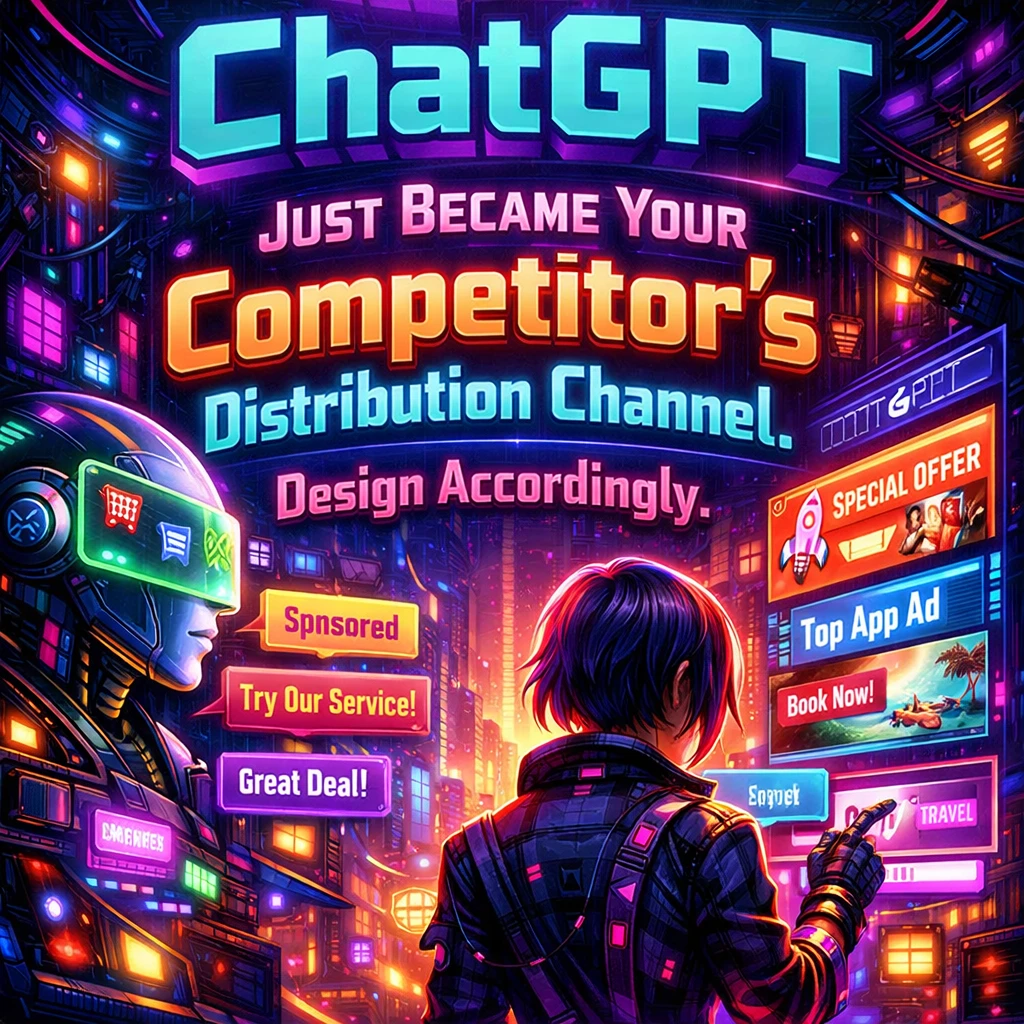

OpenAI’s expansion of ads in ChatGPT significantly alters how startups should approach user acquisition and onboarding design. Rather than traditional media spend strategies, founders must recognize that ChatGPT functions as a trust layer, presenting a synthesized answer to user queries, which creates a unique acquisition psychology.
Startups must ensure their products are easily understood in a single sentence to effectively capture users arriving from ChatGPT ads. This requires a shift in onboarding design to meet users at their point of inquiry, delivering immediate value rather than employing generic introductory sequences. A test of clarity in messaging and user experience is advised before pursuing ad strategies.
Most founders looked at ChatGPT’s ad expansion and immediately opened a spreadsheet for media spend. That is the wrong reaction.
OpenAI started testing ads in ChatGPT in the U.S. in February 2026, restricted to free and Go-tier users. By May, the platform expanded to the UK, Mexico, Brazil, and Japan. By June, retail advertisers could upload product feeds and run item-level campaigns with CPC bidding. This is not a slow rollout anymore. This is a live acquisition channel — and the implications for how you design your AI product go well beyond where you put your ad budget.openai+1
Here is what actually changed.
The Trust Layer Just Got Monetized
ChatGPT is not a search engine. It is a trust layer. When users ask it a question, they are not skimming ten blue links and making a judgment call — they are receiving a synthesized answer from a system they treat as authoritative. When a sponsored result appears in that context, it is not competing with organic content the way a Google ad competes with SEO. It is operating inside a relationship your user already has with the AI.
That is a completely different acquisition psychology — and it demands a completely different product response.
Your product’s first impression is now increasingly mediated by a conversational AI that either surfaces you, ignores you, or lets your competitor pay to show up in your place. If your value proposition is not immediately legible in a single conversational sentence — if your onboarding requires explanation before it delivers value — you will lose that impression before it counts.maciejturek
“Answer-Engine Acquisition” Is Now a Design Problem
The phrase sounds abstract. It is not. When a user comes to your product from a ChatGPT ad response, they arrive mid-thought. They already have an intent. They already have a mental model shaped by whatever ChatGPT told them. If your landing page or onboarding flow starts from zero — hello, welcome, let’s show you around — you are working against the momentum they brought with them.
This is not a copywriting fix. It is an architectural one. Your onboarding needs to pick up the thread at the point where the user’s question left off. That means context-aware activation paths, not one-size-fits-all signup sequences. It means the first value delivery in your product should happen before the user is asked for a password.
Most AI startups are still designing onboarding for the abstract new user — the one who discovered you randomly and needs to be educated. That user is increasingly rare. The user arriving in 2026 was pre-qualified by a language model that described what your product does. Design for that person.
The Harder Question Is Product Clarity
The ChatGPT ads expansion will ruthlessly sort AI startups into two groups: those whose product is conceptually sharp enough to be summarized in a sponsored sentence, and those whose product needs a guided tour before it makes sense.
The second group has a product problem, not an ads problem. No media spend fixes a value proposition that cannot survive compression.
If you cannot describe what your product does and who it changes things for in one sentence — and have that sentence still feel true when a user clicks through and hits your actual interface — you have a clarity debt that ads will only make more expensive.
One Concrete Move
Run this test this week: write the ChatGPT-style sponsored sentence for your own product. Something like: “For founders who need X, [your product] does Y — no setup required.” Then load your current onboarding and ask honestly whether the experience that follows actually delivers on that sentence within 60 seconds.
If there is a gap between the promise and the experience, close that gap before you open any ad account. The acquisition cost of a broken first impression just went up.
At Poplab, we work with AI startup founders specifically on activation design and onboarding architecture — the precise gap between “user arrived” and “user understood the value.” If your onboarding is still a generic SaaS tour, it is worth a conversation.

Leave a Reply